Category: Reading Room

  • 10 Principles Of Good Church Website Design

    Want to make sure your church website follows the principles of good church website design? Then stop coding that rotating Flash banner you think is cook and start learning how user-centric design has become a standard approach for successful websites with high conversion rates.

    The article includes eye scan reports/models to check for page hot spotsAnd in order to use the user-centric designs that make for a good church website experience, we first need to understand how users interact with web-sites, how they think and what are the basic patterns of users’ behavior. A good place to learn how this is via a recent Smashing Magazine article entitled “10 Principles Of Effective Web Design.”

    In this article, the author asks and answers the question “How do users think?” by correctly asserting:

    Basically, users’ habits on the Web aren’t that different from customers’ habits in a [bricks-and-mortar] store …

    … Most users search for something interesting (or useful) and clickable; as soon as some promising candidates are found, users click. If the new page doesn’t meet users’ expectations, the Back button is clicked and the search process is continued.

    The reasonings for this point are simple issues of common sense:

    • Users appreciate quality and credibility;
    • Users don’t read, they scan;
    • Web users are impatient and insist on instant gratification;
    • Users don’t make optimal choices;
    • Users follow their intuition; and
    • Users want to have control

    eye scanning - movement tracing results from the articleThe article expounds on each of the above points not only in word but in the deed of citing eye tracking scan paths of sample pages. The article doesn’t stop there, enumerating in detail 10 principles of good web design that we all can apply to our church and/or charity websites. The principles being:

    1. Don’t make users think
    2. Don’t squander users’ patience
    3. Manage to focus users’ attention
    4. Strive for feature exposure
    5. Make use of effective writing
    6. Strive for simplicity
    7. Don’t be afraid of the white space
    8. Communicate effectively with a “visible language”
    9. Conventions are our friends
    10. Test early, test often

    I’ve made similar points, only not as concise and well outline as the aforementioned article.

    So why not read it, then come back here for some discussion and comments on how the above points apply to your particular circumstance.

  • Jakob Nielsen: Four Bad Designs and a 403 error to boot!

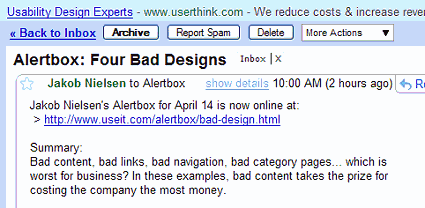
    What could be more ironic than to receive an email from Jakob Nielsen’s Alertbox on the topic of “Bad content, bad links, bad navigation, bad category pages” that links to a page that throws a 403, permission access denied page?-) Fortunately for you, I got screenshots, followed by some commentary on the article once the good folks at UseIt.com realized the error or their ways.

    First the email:

    Jakob Nilesen’s altert box email of 14-Apr-08

    Then the broken page link:

    Jakob Nilesen’s broken page link to 4 bad design

    Now onto the article …

    Yeah, I know, I’ve offered similar errors before – but then again, I’m a one man operation who posts whenever I feel I have something compelling to discuss. In this case, I think the content of Nielsen’s article “Four Bad Designs,” once liberated from the restrictions of an errant and untested .htaccess file and/or mod_apache directive provides both a compelling and worthy discussion of:

    Bad content, bad links, bad navigation, bad category pages… which is worst for business? In these examples, bad content takes the prize for costing the company the most money.

    Bad Content: Jazz at Lincoln Center

    Here, the good Dr. poses the age-old question “where’s the beef!?” And while his point is about scant detail about an upcoming performer, I could say the same applies to church websites when announcing guest speakers and/or special events.

    Links without Information Scent: New York Times

    If Jakob Nielsen were writing about church websites, he’d perhaps pose the question ‘Who’d want to click on “Next Sermon in Tithing”?

    In other words, give your links some “what’s in it for the reader” type jazz.

    Interior Splash Pages: Christopher Norman Chocolates

    This is directed at the growing number of church and/or charity web masters who think for some reason it is compelling and cool to embed huge, bandwidth consuming Flash-based slide shows for each and every category of your website.

    I think Nielsen sums up my opinion of this sin when he opines:

    Splash screens are bad enough when they sit in front of a site’s real homepage, but at least users encounter those screens only once. With a splash screen for every category, users have to click through many extra pages to see all the products.

    Amen, preach it brother!

    Metaphor Run Amok: Specialized Bicycles

    Dr. Nielsen’s point also applies to gizmos, gadgets, and special effects that continue to plague a plethora of parishioner inspired web pages.

    The Business Cost of Bad Design

    Two words: empty pews.

    Meaning, the general reaction by first time visitors to the above design issues is that they become one time, never again visitors.

    Think about that the next time someone comes to you with a a website idea that is more style than substance. Better yet, send a link to this article to your pastor and youth minister – so the next time they hit you up with a “great idea” you can remind them of that “4 bad designs” article link you sent them back on April 14, 2008.

  • 8 more love notes from my mailbag – mostly great questions

    Now I know how Santa feels – as my mailbox is getting stuffed with comments, questions and yes, a few complaints. So “once more into the breach” … answering excellent questions, re-posting useful commentary, and responding to spammers with the attention they so richly deserve.

    From the “most useful comment” category …

    … we have this tip from JT in response to my post entitled ‘5 Simple Security Tips for the WiFi-ing Road Warrior:’

    On (3) “Surf Encrypted”, the easy way to GMail securely online is to save the secure link to GMail in your bookmark, and enter it when you browse from a public-access terminal.

    The secure link is https://mail.google.com. Of course the only difference is the ’s’ after ‘http’. If you’re already logged in, adding in this ’s’ at the top and pressing enter will do the trick also.

    Excellent advice for you missionaries seeking secure email while in the field.

    From the “speaking of email” category …

    Cinthia P. asks:

    Can I use the email addresses provided by members as part of contact information for church communications without asking them specifically for each use?

    I think the best answer for this question can be found in my post entitled ‘The CAN SPAM Law and your church’s email distributions‘ where you’ll see that while some may debate specific usage – all can agree that you really should provide each recipient with an easy opt-out solution for all communications.

    That said, if you’re worried about specific use, then do what some online and offline registrations do and offer multiple check boxes – one per usage type (e.g. newsletter, product announcements, event notifications, etc …). It probably also doesn’t hurt to publish a ‘Privacy Statement‘ that explains the extent to which a members contact information will be used.

    From the “most encouraging comment” category …

    I happened across your site and have enjoyed reading a few of the articles … so many of the scenarios make me chuckle … I think the articles on this site have given me a little lift …

    Thank you Carol from carricdesign.com, knowing we’re serving great people like you makes it all worthwhile!

    From the “please don’t spam the Dean” category …

    I dunno why, but the following folks feel they need to use the comment form to send me entire sermons preaching doom-n-gloom, soliciting ‘donations’ and/or attempting to sell me Jesus junk:

    bcgblessed@yahoo.com, churches_save_property@hotmail.com, mneese@aol.com, jlarsensd@gmail.com, socalboarderdude@gmail.com, jackelmore@insightbb.com

    From the “pictures from Petra club” category …

    Just wanted to let you know that I have a bunch of pictures of Petra and Jordan from a trip I took a little over a year ago …

    Thank you Josh Byers (.com) for sharing! Excellent pictures I’ll be linking to blogJordan.com very soon!

    From the “interesting question” category …

    Bill J. ponders:

    Should a Christian owned business operate by the same web principles as a church? or do the rules change in a “for profit” business verses a “non-profit” entity? As a Christian business owner I am seeking direction in this area. Thank you.

    Wow, this probably deserves its own post, but for now, my initial thought is that while the operations of both entities are bound by Biblical principals – the business models are different enough to justify differing approaches based on the conversion goals of each.

    From the “holy Scripturizer plug-in for MoveableType” category …

    Aliotsy writes that:

    I’ve been looking for your Scripturizer plugin for Movable Type. I see that you’ve switched to WordPress — is the MT version no longer available?

    Hmmm … it’s available but it appears WordPress 2.3 ate it! I will get it back online this weekend – thanks for the heads-up and apologies for the inconvenience!

    From the “holy Scripturizer plugin for WordPress” category …

    Jon Davies informs me that:

    It’s *really* nice to know that there’s someone else out there wanting to make church websites half decent. I dug up your site cause I’ve got a 2-line patch for the holyscripturizer which fixes incorrect detection of things like “Children Act 1989” as a ref to Acts 198. Where would you like me to send it?

    While Scott informs me:

    I fixed the WP Holy Scripturizer plugin so the that icon now works in 2.3 – email me and I’ll pop the updated file as an attachment.

    Hi Jon and Scott, apologies for the late response, but there are two efforts (forks) listed on the WordPress website that would probably enjoy your enhancements at:

    From the “But wait there’s more!” category …

    Yes, there’s more email I’ll be following-up in the next day or three, including

    • discussions on pictures, privacy and security
    • perhaps a quick overview of online registration solutions
    • a need to update my post on blogging as a church CMS solution on the cheap
    • requests for a critique of their church’s website; and
    • someone REALLY mad at me for critiquing their church’s site

    I also think it’s about that time of year I get rolling with my 12 days of Jesus Junk postings as well.

    Again, keep them comments and questions coming – if it keeps up at this pace I think I’ll need to begin podcasting once a week to keep everyone up-to-date – especially myself.

  • 5 love notes from the mailbag

    I’m usually very responsive to comments and emails – as such interaction often results in long-term, online friendships with other developers. That said, sometimes I get ‘love notes’ that either request assistance when I’m mega-busy, or whose purpose is to tear me apart for ‘bashing the Body.’ Here are 5 examples of such – followed by some witty snarkasm on my part.

    1. A Misraelite responds to my article entitled ‘Why Christians Should Have Nothing To Do With Snowmobiles:’

      I was doing research on why people are turned off by Christianity. I could not believe what I read! Riding a snowmobile is a sin? There is no scripture that backs that up! These are the types of things that would make people wonder away or make them not even consider becoming a Christian! In fact, I challenge you to make this a ministry that could be used to bring souls either to christ or closer!

      My Response: Personally, I think alot of people are turned-off by the great cloud of witlessness who don’t know a joke when they see it.

    2. A gutsy steward asks:

      Dean – So we’re an old school Presbyterian Church … We’ve gone from no website, to a simple wordpress template.The initial idea was to have something functional online while we develop the real thing.

      Would you be interested in using this as a test case / makeover show for creating a website that does work? For recommending how to take something basic like this and making it a functional web residence for us?

      My Response: Yes. I love a teachable spirit, as exemplified by your courageous offer. Expect an article next week w/at least 5 pointers that encourages others to do likewise (in love).

    3. A quick email with a quicker response:

      How can I create a Sermon page with all the sermons so that viewers can select the sermon or sermons they wish to view?

      My Response: A sermons blog. WordPress on your own server, or Blogger on Google’s – both are great places to start. You can even use Google Docs to post to either once you get things established.

    4. From the flanks in response to ‘Too cool for Old School – Sonrise Baptist Church Newnan, GA:’

      How did you find this church in Newnan, GA? Out of genuine concern for this church, did you contact them and encourage them with your criticism?

      My Response: Out of genuine concern for the Body online, I have spies everywhere. Seriously, I would think such a genuinely concerned person would have contacted those involved in said website – which is why said question has me a bit suspicious over such ‘genuine concern.’

    5. From the ranks, also in response to ‘Too cool for Old School – Sonrise Baptist Church Newnan, GA:’

      Why, everywhere you go, do they insist on hiding the service times. Even on the directions and service times page, they are hidden. And they are hidden under sideways text, which is even worse.

      My Response: Out of genuine concern for everyone concerned, to keep me off the streets at night.

    So there you have it folks! Five reasons to keep them comments and love notes coming!

  • Why Christians Should Have Nothing To Do With Snowmobiles

    7 reasons why snowmobiles are sinful, or a comic-serious example of foolish arguments often used to “prove” that certain things are “worldly” by Norman Street of Diaphero.org – reprinted with written permission:

    Before I became a Christian I went snowmobiling most winter weekends and thoroughly enjoyed it. But now I see the pastime in a different light. True, the church I attend is against snowmobiles and to teach a Sunday School class I had to sign a consecration pledge stating that I do not own a snowmobile and will never ride one. I think that I would have come to this conclusion anyway, because anyone ought to be able to see (if he really thinks about it) that the whole sport of snowmobiling is “out of bounds” and Christians need to think twice before they do anything “just for fun.”

    the devil's work in hot green

    Perhaps it will help others to avoid this form of worldliness if I present some facts and arguments.

    1. Snowmobiles are sinful.
    2. Snowmobiling is a waste of time. Christians are always pleading that they haven’t got time for Bible study. They are too busy to help in the youth work at the church, etc., but they have time to go snowmobiling. Anything which takes up time better spent in spiritual things is wrong for a Christian.
    3. Snowmobiles are harmful to those who ride them. Not only are they in danger of harming themselves, but they may do great harm to others. The finger of suspicion points straight at snowmobiles as the likely cause of increased incidences of ruptured discs necessitating spinal fusions and many other physical ills caused by being jostled and slammed up and down in a vehicle with scarcely any springs or shock absorbers.

      Those who ride them like to invite their friends to join them in the sport. Some of these not so experienced as the owners have suffered serious injuries in accidents such as broken arms and legs. We have heard of people travelling at high speed being decapitated by wire fences. Surely it is wrong for any Christian to endanger his life in a snowmobile.

    4. Snowmobilers have a bad influence. People who own snowmobiles and spend a lot of time with them influence others to get as glued to the sport as they are and Christians should not have such obsessions except in spiritual things things related to the Lord’s work.
    5. Snowmobiling Leads to Worse Things. In spite of all I have said you may not be convinced that snowmobiles are a great evil, but you cannot deny this: they could be the thin edge of the wedge of worldliness creeping in and we must guard against small beginnings.The thing may not be so bad in itself but if it leads to sin then what are we to say? In some places it seems that all trails lead to the tavern where you will see dozens of snowmobiles parked outside.Others go in for racing and of course bets are placed, so the sport brings the Christian into the company of people who gamble and drink. Some of the worst people drive snowmobiles. What part can a Christian have in this business?
    6. The Matter of Christian TestimonySnowmobiles are an annoyance to many people.  They roar up and down polluting the air with exhaust fumes and at night their lights distract motorists and flash into people’s houses. Farmers are afraid to go out at night on their own property for fear they would be struck down. Snowmobilers have no respect for other people’s property or privacy.

      Any Christian wearing a snowmobile suit is therefore a poor testimony. He is bound to be a stumbling block to others. People will say “If that’s what Christians do, count me out. I’ll have nothing to do with Christianity.”

    7. Snowmobiles are an invention of the devil. When the automobile, “the horseless carriage” was invented, preachers warned that it was an invention of the devil and they were laughed at. But no one can deny that the automobile brought on a weekend pleasure craze which kept thousands of people away from the churches.

      How many parents regret that they ever bought an automobile or ever taught their own children to drive? Parents, knowing the dangers were always careful about how and when they used their automobiles, but their young people were reckless. Some drove too fast, killing themselves and injuring their friends. Others parked the automobile down some lovers’ lane . . .The same will be true of snowmobiles. Mark my word. So now you can understand why I will never own a snowmobile. (The fact that I cannot afford one has nothing to do with it.) Nothing could be more worldly than riding snowmobiles and a Christian is plainly told “love not the world, neither the things that are in the world”.

      Furthermore, I will not have fellowship or associate with snowmobilers or with those who do not own snowmobiles but are friendly toward those who do.

    Snowmobilers all sinnin' together

    We would like to meet with others who feel as we do with a view to stamping out snowmobiles. If we could get enough Christians to take a strong stand on this we could form a lobby and work to get legislation enacted prohibiting the manufacture and sale of these terrible machines. We could go from there to tackling other things which take people away from the church every weekend, such as camper and larger pleasure vehicles and private airplanes.

    – – – – – –

    You are not serious? Of course not! But I want you to think. These are the kinds of arguments Christians use to prove that certain things practices, or pastimes are worldly. All we do is prove that we are not very smart and we succeed admirably in looking ridiculous. Many things dogmatically stated here as fact are not even true. Fallacious arguments disgust thinking people. By such arguments as I have used you could strip yourself of everything even your body as the ascetics did. No matter how tired you may be, don’t ever lie on a bed. Wicked people do that. Don’t ever print anything. There’s a lot of bad stuff in print. So, of course, we would never print Bibles.

    Misguided Christians have carried this kind of twisted, illogical thinking to the point where any kind of game or sport or pastime became a sin. Piety was measured by the number of pleasures prohibited; to young and old alike, they had one answer. “You should find all the pleasure anyone needs in work. Enjoy your work. You must not indulge in the world’s foolishness. If you were the Christian you should be you would use leisure hours for Bible study and prayer. You would not be trying to fill the hours with empty pleasures.”

    If I should ask you what is worldliness, how would you reply? With a list of things to be regarded as worldly? Would that be your first answer? Would that be your full answer? I have been a Christian for 50 years and a Pastor for 40. I have learned that Christians whose definition of separation is in avoiding certain things, are likely to be blind to other forms of worldliness. In the sight of God these may be far more damaging to their souls and the souls of others than some of the taboos commonly held by certain groups.

    What do I mean? The spirit of Esau, who would not wait is the worldly spirit of many Christians. What they want, they want now and they get it now. This instant satisfying of every desire, this covetous, materialistic spirit makes Christians appear to be well-off. In reality they are painfully strapped with debt, very unhappy, and unable to give generously to the Lord’s work. That spirit of Esau is surely not of the Father, but of the world.

    Many Christians cannot be content with anything; car, house, furniture, clothing that is not either brand new or in “mint” condition. They knock themselves out trying to keep everything up to an impossible level of perfection. And what are all these things they are so “careful and troubled” about (Luke 12:15)? Temporal things that soon must pass away. Things of this world. That obsession with things and their perfection is worldliness.

    I have seen Christians totally worldly in these and other areas yet so completely unaware of the fact, that they felt themselves to be in a position to judge other Christians because they broke one of the separation taboos. Lest there be a misunderstanding at this point, we need to remember that there are some things which evangelical Christians have always felt should be avoided for the sake of one’s Christian testimony. We may not always agree on each debatable subject but we must respect oneanother’s conscience in these matters.

    Sometimes the list of things prohibited becomes very long because some items are clearly worldly and sinful while others are only considered to be, although it would be difficult to show biblical proof. Such things, in that case, are nothing more than the traditions of the scribes and pharisees in “Christian” guise.

    Happy are those who know the difference between truth and tradition! And happy is he who heeds our Saviour’s Word about removing the beam from his own eye before criticizing or refusing to fellowship with a brother who has only a mote in his eye.

    That thing in our hearts which causes us to set our brother at naught (Rom. 14) and judge him as not qualified to serve in this or that office because he does not agree with us in debatable matters; that spirit is infinitely worse than whatever the “unseparated” brother is doing. Nor will that attitude ever help anyone to deeper consecration, because it is not the spirit of Christ.

    “Lord, what wilt Thou have me to do?” If only that could be our prayer each day. If it is not our heart’s desire to please Him, then what? Nothing else will really work. We can make up our consecration pledges for workers to sign, we can set down lists of things to be avoided by our members, but legal requirements are not God’s way of holiness. Church history clearly shows that those who will conform to legalistic standards inevitably become pharisees.

    True godliness, true consecration, true separation from worldliness and sin springs from only one motive: love for Christ in response to Calvary.

    Love so amazing, so divine,
    Demands my soul, my life, my all.

    That Christian who is constrained by such love, and no other, is free. Free to enjoy innocent fun; Free in testimony. Free in prayer. Free in witness. Free from fear. Free from bondage. Free indeed!

    note: this article was reprinted with written permission from Diaphero.org … thanks for letting us enjoy this here!

  • Submissive Volunteerism versus Spiritual Abuse

    Jesus defined the elements of volunteerism in Mark 10:42-43 and Matthew 23:8. There is only one Master, the rest of us are servants of whom the least will be the greatest. Problem is, when it comes to highly visible ministries such as the church’s web page, parties involved tend to forget that Christ is the Master, and being the least does not mean being a door mat to bullies and blow-hards.

    It’s been almost 12 years since I involved myself in any study of spiritual abuse. No need to since I was helped out the door of a church suffering said ailment in the form of pastoral worship. Here’s the short story:

    • A pastor of 39 years gets the heave-ho by the deacons, and is soon replaced with a new, charismatic personality guy pastor arrives
    • I teach a Sunday school class where I generically warn the 10th graders to test everything, including a pastoral message
    • I get a note on New Year’s Eve telling me I’m no longer a teacher, a week later followed-up by a ‘lay staff’ member, also a Secret Service agent by day, who explains to me that I’m not qualified as I insist my students bring their Bibles to Bible study (he, NOT noting that I gave free Bibles at my own expense to those who didn’t own one &/or were still equipped with a ‘kids’ version).
    • I’m told I need to change my attitude. Others are similarly given the boot for equally bogus reasons.
    • Later it comes out the pastor has a past in the form of an SEC investigation and a personal bankruptcy.
    • Pastor gets up in pulpit and divides church with “those who are with me come forward and show your support” … pastor of singles ministry takes note/names of those who don’t go forward.
    • Five years later, the Washington Post reports said pastor resigns, something about a very, very large sum of money missing due to a tuition scandal/scheme involved with the church’s Christian school.
    • Going back in hopes to see if thing can be healed, I’m excoriated along with others as being the cause for the pastor’s demise.

    So when I read a comment regarding volunteerism being an issue of authority – understand that while I agree one must have a servant’s heart – on the other hand one must be careful of church and charity organizations that exhibit some of the following qualities based on Jeff Van Vonderen’s book, ‘Subtle Power of Spiritual Abuse:’

    Out-loud shaming
    basically belittling born out of “something is wrong with you” if you don’t step into line with your attitude.
    Focus on Performance
    how important you are is based upon earning favor w/those in charge, rather than by administering God’s Grace
    Manipulation
    relationships and behaviors are manipulated by very powerful unspoken rules that facilitate shaming messages
    Idolatry
    focus on performance is facilitated by impossible-to-please judges who distort the image of God to get their goals
    Preoccupation with Fault and Blame
    responsibility and accountability are not the issues here: Fault and blame are the issues. The shame-based system wants a confession in order to know whom to shame.
    Obscured Reality
    if you’re thinking critical about those in authority – even if it is based on truth, then something is wrong with you, you need to change your attitude bub; this starts by ignoring and/or obscuring the actual truth.
    Unbalanced Interrelatedness
    rules take the place of people that feeds upon one’s fears and need for structure in the form of placing the burden of all problems on your shoulders, making you feel selfish and guilty for having needs, not submitting entirely to pastoral authority and/or noting that anything is wrong.

    Note – I’m not asserting that said commenter implied any of the above, but rather their comment jogged my mind into putting the topic of volunteerism and spiritual abuse together. A topic which I could write and speak about for hours, but for the sake of brevity – there are three simple solutions to overcoming spiritual abuse masquerading as volunteerism:

    • Scripture
    • personal boundaries
    • technical specifications

    One need only read about Christ’s interaction with the authority figures of His time to see how ancient the problem of Spiritual Abuse is – and how a single Master, servant-hearted Body focused on loving one another by Grace will get around said problems;

    I might start with Matthew 23, where Christ defines some serious boundaries so the volunteering of your time and technical talents isn’t turned into an opportunity to shame and guilt you into adding animated gifs, auto-loading audio, and a huge image worshiping the pastors proboscis on the front page.

    I’d then do some reading on how to structure a software design description (SDD); the IEEE 1016-1998 has always been my favorite. Having such a formalized process – and an established timeline – will further keep glory seekers and self-appointed ‘experts’ in check, while protecting you from enslavement to never-ending feature creep.

    I’d also then consider reading my post entitled “Mr. Zeldman meet Mike Boyink, one of ‘The New Samaritans’” – and realizing then the need to structure your relationship with your church as you would with any web project and client; even if it means running it like a business. Trust me, the alternative only provides the evil-one with opportunity to ruin your walk, and divide your church.

    There’s more on the topic, much more on this topic that can be found at Watchman.org – starting here:

    Some other useful URLs on this topic as well:

    Again, let me make it clear that I do not interpret last night’s comment was from the spiritual abuse camp, I don’t interpret it that way. It just merely made me think about the topic of where a good servant attitude ends and where spiritual abuse begins; and how perhaps some good old fashioned technical specifications might help avoid the whole mess.

    Yes, please feel free to discuss this topic freely here – disagreement in love is always welcome here!

  • Volunteerism and the Robert E. Peary Class of 1977 Reunion

    This weekend the Robert E. Peary High School Class of 1977 will hold its 30th year reunion. Whatever comes of the events, one notable failure will be the lack of a strong and effective online presence similar to those suffered by many church and charity websites. Here’s why:

    Some Context

    See if this story doesn’t sound familiar to some of you who have offered your time and talents to church and/or charity web sites …

    .. back in early March of this year, I emailed the reunion committee and offered the following resources for free:

    • free web hosting for the site – all bandwidth included
    • set up a domain name if I/we/you/the committee chooses to buy one
    • provide limited but sufficient email & listserv services to the domain
    • set up an open source community/content-manglement application – such as WordPress
    • set it up with adsense with any click through going to an account established of/for/by … “the committee”
    • support the committee’s need for document collaboration through Google Apps
    • track website usage using Google Analytics
    • hand the keys to the kingdom to whichever committee member wants to run the site, after providing them free online training.

    Here’s the response I got back:

    Thank-you for getting back to me. Let me tell you what we hope to accomplish and you can let me know if you can be of assistance. Please understand in my mind I think what we want is fairly easy and straightforward but then again I have 3 dedicated web staff members who would tell you that I am not always thinking straight. We would like to be able to handle the ticket/advertisement/contribution sales for the reunion on the web. We want to do this for several reasons:

    • Ease to classmates of handling purchases on-line and being able to use a credit card for payment
    • Cash going directly to the bank rather than sitting on someone’s kitchen counter
    • Having a data source for sales so that we do not have to reenter contact information for badges, advertisements and memory book messages

    We are planning on opening a PayPal account to handle the secured payment processing. With the PayPal service it is not necessary to have a shopping cart on the website. In addition, I do not think that we need a dedicated domain as this is a brief project and I have asked [name witheld] if we can put a direct link on the [alumni] site. I envision having a form for classmates to fill out that includes:

    • contact information
    • guest information
    • number of tickets to be purchased
    • cash contributions
    • advertising to be purchased (full page, 1/2 page, 1/4 page and business card)
    • total purchases
    • description of donated items
    • actual ad (pdf format?)
    • memory book statement
    • photos

    As several people on the committee would be working with the data for badges, memory book, etc., we would need multiple access to the data. While a standard text box could be used for the memory book statement, it would not be a problem to have the ad & photos submitted separately through e-mail and outside of the webpage.Please let me know if this is something you could help us with or if you have any other questions.

    The Problem

    In other words “… forget about what you have to offer in terms of a free online community with collaboration, tracking and ad revenue tools – we have an an overly-ambitious e-commerce and badging system in mind, so please limit your thinking to our’s or else no thank you…

    Such responses are not uncommon with churches and charities as well.

    I’ve both experienced and heard via email from a number of you instances where talents offered were talents ignored because it was ‘outside the box’ limiting vision the person in charge.

    Well in some cases, I think it’s an issue of control.

    Examples

    For example, I’ve offered to help with (and not take over) the website of the church I currently attend. The pastor has eagerly handed this offer off to a member of the staff. The staff member has politely ignored my offer – instead opting to wander in the wilderness of PHP failures for six months until they finally subscribed the Community Builder service. Which not a bad choice – but one that could be better leveraged with more effective presentation than what is currently implemented.

    Similarly, when I first moved to the area, I had considered joining another church here in town until I asked about being involved with their web presence. There I was told flat-out that the web committee was set – and would have to wait a year or three before considering my aid (even after explicitly assuring them that I would help, not take-over). As I check on the site today, I see almost 2 years later that not much has changed.

    Finally – that ambitious Robert E. Peary High School Class of 1977 reunion site mentioned in the above communications? I’ll link it up here and let you judge for yourself.

    My Point

    So is this post merely kvetching?! Ah, probably a little – but not because I’m bitter – heck, them saying no only means more spare time and less work for me!

    Rather my post is a wake-up call is to pastors, church staff and other individuals charged with the stewardship of their church and/or charity’s web presence.

    When an individual offers you a loaf of bread – don’t return the offer with a rock (yes, I know that’s an inversion of the metaphor).

    Or put another way, when experienced web developer, a paid software as a service product manager and published usability author is offering their time, resources and talent – cool it with the worries about control and instead consider what it might cost your organization to hire out such expertise and/or services.

    I know I’m not alone here, as some of you have emailed me similar accounts of frustration.

    If so, leave a comment here. It’s time church staff and committee chairs quit ‘beefin‘ about time, tithes and talents while squandering that which is already being offered.

  • more Seven Deadly Sins of Web Design

    Web design sins are generally the product of inexperience. And as experienced sinners, we’d like to help you avoid these deadly mistakes – some that we’ve made, and others that we see every day.

    Pride

    Here’s a Web design secret – not everyone on the Web will be viewing your Web pages with your cool computer system. The Web is composed of a diverse group of people, all of whom have different combinations of computer, operating system, platform and Web browser. The sin of pride in Web design is failing to consider how your design choices will affect your audience.

    • FireFox, Safari and Internet Explorer (MSIE) display Web pages differently (depending on the features that you have added to your page). It is important that you check your Web pages on FireFox, Safari and MSIE for inconsistencies.
    • Web pages can be interpreted differently by different versions of the same browser. Internet Explorer 7.0 has some features that won’t work at all in MSIE 5.0. So it is good practice to check your Web pages in as many versions and browsers as possible.
    • Web pages can look different on different computer platforms. For example, Macs show fonts two point sizes smaller than PCs with the same point size specified.

    Also keep in mind that not everyone viewing your pages has the same physical advantages. Visually impaired individuals may be browsing your site with a text to speech reader. (A text to speech reader will read only the text on your page.) If you use mainly graphics on a page, the text to speech reader has no text to read. Make sure that you represent all important images with an alternative text attribute. (You can generally configure alternative text in the image properties.) Alternative text makes your Web site more accessible not only to the visually impaired, but also to people with slow connections or older video cards.

    Envy

    There is a lot to envy on the Web – sites that have brand new interactive components, flashy visual technologies, incredible internal structure – envy is understandable. But using the new thing without understanding it is a very bad idea. It takes time and experience – expertise – to make new technologies effective and older technologies innovative.

    Finding information about new technologies on the Web is relatively easy. And step-by-step instructions for the most innovative use of older technologies are readily available. But there is a great difference between knowing what to do with a technology and knowing how to do it.

    Understand before you implement. Read about the new thing before you try to use it – and ask a lot of questions. Is there a standard? Will it work in all browsers? If not (and it’s probably not) which ones will it work in? Are those the browsers that hit UNT most often? Is there a way to convey the information differently for older browsers? And please, don’t forget the most important question: will it add value to my site?

    Find sites that use the innovative technique badly, and avoid their mistakes. Find sites that use the new technology well, and build on their success.

    Gluttony

    Graphic overindulgence on the Web is very common. The relative ease of use combined with the frequent lack of a design background in novice Web workers creates some interesting forms of self-expression. Graphic design is indeed important to the Web. The Web as we know didn’t “take off” in popularity until images were added. But there are a few rules to keep in mind when you are creating your page:

    • Images add download time to a page. Use graphics wisely. This includes learning how to make images that download very quickly. You can check out builder.com for hints on tweaking your images for speed.
    • Animated .gifs are the plastic pink flamingos of the Web world — decorations of questionable value. An animated .gif does add motion to a page — but is a rotating, flaming email icon really enhancing a page when the visitor has to sit through a longer download ? How impressed is the reader seeing your whirling, pulsating “New” icon for the fifteenth time?
    • Background and text colors can be changed on a page, but should not be changed without a good reason. The most legible combinations of text and background are high contrast – dark text on a light background or light text on a dark background. Red text on a green background is bad – the low contrast between the colors will make that page very difficult to read. Black text on a white background is optimum.
    • Although the default link colors can be customized, remember that a good portion of the Web audience is new. Novice Web users understand that the blue underlined word is a link. Be very careful that your color changes don’t confuse your Web site’s navigation. Link colors must contrast strongly with the background color but should NEVER be the same color as the regular body text.
    • Finally, a brief word about background images. The purpose of your site is to present information to your audience in an effective manner. Make sure that your background image doesn’t make your text difficult to read. As Creating Killer Web Sites (by David Seigel) says, “gift wrapping paper makes bad stationary”.

    Lust

    Every day brings a new toy or technique to the Web. And everyone wants to be on the cutting edge of design — to show the world just how tech savvy they are. However, you must avoid the temptation of adding these new technologies for the sake of the technology alone. Techno-lust has been known to lead good Web designers astray.

    For example, there is no need to use a scrolling Java applet to present a list of subjects on your site. People with browsers that don’t support Java can’t see the list. People with browsers that do support Java won’t necessarily see it, either. Java and other technologies such as Flash, DHTML, AJAX, and RealAudio have limitations and do not work consistently for all browsers across the Web.

    These technologies were created to address specific needs — to serve some specific purpose. A trendy new technology’s existence doesn’t make it appropriate for the task at hand. Always strive for a solution that will benefit the widest possible audience.

    Your content should drive the technology that you use — not the other way around.

    Anger

    Would you like to drive your readers to the sin of anger? Then be sure to:

    • Link to pages that don’t exist — those animated under construction .gifs are a fine substitute for the missing information! (Not Really! Avoid making your readers angry, and debut new pages or areas of your Web site when – not before – they exist. Draw attention to your new material, not the lack of it.)
    • Ignore screen resolution issues! If you’ve got a 19″ monitor running 1024 x 768, then design for that, because everyone else has one, too! (If you are unfamiliar with these terms, you can learn all about the the perils of screen resolution at Andy’s Art Attack, a particularly good source of image information.)
    • Don’t provide any email contact information on your Web site. What could your readers possibly have to say to you? (You’ll avoid compliments and complaints by not providing contact information. You’ll also miss out on opportunities to help current and prospective students find the information they need. Read UNT’s Web Publishing Guidelines for more information.)

    Greed

    You’ll see marvelous images on Web sites — wonderful sound and animations — and brilliant content. You’ll want it all for your site. We understand this greedy impulse. But copyright is as real on the Web as it is in print. And while it is easy to take graphics, sound, text and more from Web sites, it isn’t right or legal without the permission of the copyright holder.

    There are hundreds of Web sites that allow the use of their images in exchange for a link back to their site. If you use their images, follow through on your part of the deal, and link back to them. If you find an image that you can’t live without, and are unsure of who owns the copyright for that image, send the site owner email. Ask permission to use the image, and keep the email that gives you permission. Realize that permission for a cartoon, a science fiction character or your favorite song is very hard to come by, and generally costs money.

    If you really like what someone else has said or shown on their site, provide a link to that site! That gives the original artist credit, and keeps you out of the copyright business. If someone challenges your use of content that you did not create, apologize and remove the challenged content. (Read about why on Law and the Web at builder.com.)

    Sloth

    It’s been said that Web site creation and procreation have something in common — that the act of creation is much more exciting than the care and feeding that inevitably follows. And while a Web site is less demanding than a child, failure to maintain a Web site is the deadliest of Web design sins – sloth.

    UNT’s Web Publishing Guidelines clearly state that you should only put on the Web what you can maintain. Inaccurate and out of date information reflect badly on the university as well as the individual responsible for the Web site.

    A few other hints:

    • Run a spell check on your Web site. If spell check is not available, invest in a dictionary. Incorrect spelling is particularly inappropriate on a university Web site.
    • Check your links on a regular basis. Web sites move or reorganize frequently, and they’re not likely to notify you of the change.
    • Indicate the date each page was updated last. This freshness dating lets your readers know how often the page is updated while encouraging you to keep your Web site current.


    please note

    This is a repost from 09/01/02 w/minor modification. Copyright 2002 Univerity of North Texas. Reprinted with the explicit, written permission of Kenn Moffit, Director of University Online Communications University Communications & Marketing