Blog

  • 5 love notes from the mailbag

    I’m usually very responsive to comments and emails – as such interaction often results in long-term, online friendships with other developers. That said, sometimes I get ‘love notes’ that either request assistance when I’m mega-busy, or whose purpose is to tear me apart for ‘bashing the Body.’ Here are 5 examples of such – followed by some witty snarkasm on my part.

    1. A Misraelite responds to my article entitled ‘Why Christians Should Have Nothing To Do With Snowmobiles:’

      I was doing research on why people are turned off by Christianity. I could not believe what I read! Riding a snowmobile is a sin? There is no scripture that backs that up! These are the types of things that would make people wonder away or make them not even consider becoming a Christian! In fact, I challenge you to make this a ministry that could be used to bring souls either to christ or closer!

      My Response: Personally, I think alot of people are turned-off by the great cloud of witlessness who don’t know a joke when they see it.

    2. A gutsy steward asks:

      Dean – So we’re an old school Presbyterian Church … We’ve gone from no website, to a simple wordpress template.The initial idea was to have something functional online while we develop the real thing.

      Would you be interested in using this as a test case / makeover show for creating a website that does work? For recommending how to take something basic like this and making it a functional web residence for us?

      My Response: Yes. I love a teachable spirit, as exemplified by your courageous offer. Expect an article next week w/at least 5 pointers that encourages others to do likewise (in love).

    3. A quick email with a quicker response:

      How can I create a Sermon page with all the sermons so that viewers can select the sermon or sermons they wish to view?

      My Response: A sermons blog. WordPress on your own server, or Blogger on Google’s – both are great places to start. You can even use Google Docs to post to either once you get things established.

    4. From the flanks in response to ‘Too cool for Old School – Sonrise Baptist Church Newnan, GA:’

      How did you find this church in Newnan, GA? Out of genuine concern for this church, did you contact them and encourage them with your criticism?

      My Response: Out of genuine concern for the Body online, I have spies everywhere. Seriously, I would think such a genuinely concerned person would have contacted those involved in said website – which is why said question has me a bit suspicious over such ‘genuine concern.’

    5. From the ranks, also in response to ‘Too cool for Old School – Sonrise Baptist Church Newnan, GA:’

      Why, everywhere you go, do they insist on hiding the service times. Even on the directions and service times page, they are hidden. And they are hidden under sideways text, which is even worse.

      My Response: Out of genuine concern for everyone concerned, to keep me off the streets at night.

    So there you have it folks! Five reasons to keep them comments and love notes coming!

  • Pastors, programmers & graphic artists listen up: your user isn’t you

    Unless you’re writing a church website for a bunch of blogging pastors, frustrated graphic artists and/or “… burned out computer geeks, your user isn’t you. … This is very hard to get through somebody’s head; it’s very hard to get rid of this notion that what you like your user is going to like… Again, your user is not you.”

    Please pardon my blatant rip-off of Deborah Hartmann’s quote of David S. Platt’s recent keynote entitled “Why Software Sucks.”

    Perhaps it is 30 hours of planes and airports traveling back from Kuala Lumpur that’s made me a bit grumpy. Perhaps it is the head-cold inflicted on me by the sick six year old who kicked my right side most of the way home. Or perhaps it’s just the continual parade of church websites that suck that has me annoyed at the great cloud of witlessness that is the Church online.

    Probably a bit of all three. None-the-less, there’s a simple truth that I think to many of us are missing when it comes to designing and maintaining our church and charity websites which I’m hoping gets quoted and discussed web-wide:

    For the most part, people aren’t seeking the church experience online – rather they are shopping online for a real-world church experience.” – Dean Peters, HealYourChurchWebSite.com, 16Sep07.

    Agree or disagree, I’d like this meme mulled-over in as many places as possible – and along with it, the following 5 suggestions to make your church website work, based on David Platt’s 5 suggestions to ” Just Make It Work:”

    1. Add a novice to the design team: I’m thinking a silver-haired seasoned citizen as they are often overlooked, yet comprise a significant population of any church body.
    2. Break convention when needed: Quit thinking brochureware (print marketing) and/or writing like Spurgeon – the web is different.
    3. Avoid feature “silliness”: Your website isn’t a stinkin’ art project, so cool it with the cheap tricks.
    4. Instrument your application very carefully: again I’m thinking silver-haired seasoned citizen and other members of the “silent majority” who may not be geeky cool, but are the ones who need an effective church website the most.
    5. Consider whether design decisions are taking you closer or farther away from the software *just* working: this implies you have a clear understanding of what it is your church and/or charity website is trying to accomplish. Meaning, I’d document some use cases.

    In the meantime, I’m going to work on some articles this coming week to detail some simple procedures that will take your church website from cool and unused, to effective and often implemented.

    As always, your comments, questions and concerns are always welcome.

  • 5 tips for blogging sermons effectively

    Just publishing your sermon notes to your church’s blog is not enough – not if you want anyone to actually read them. Here are five simple things you can do to make your sermon notes more visible to more readers through more search engines.

    Why this is important:

    Ah sermons … the holy grail of any church website … not only because they provide church webmasters with a source of dynamic and (hopefully) compelling content, but because the (hopefully) compelling content serves seekers and members alike.

    Problem is, many sermons online go unread because they’re posted “as-is” rather than following these five simple steps that will (hopefully) increase their visibility on various search engines – especially Google:

    1. Put your key content on top

      Search engines index by title, so if you have some key words that represent your key points, put them in the title of your post – even if it is slightly different than the title of last Sunday’s sermon.

      Search engines display excerpts after the title – so help your readers out by putting your key points in those first 128 words or so.

    2. Lose the church-speak

      Don’t compel those not familiar with the vernacular of your congregation to have to learn a dialect of ancient Greek just to figure out what you’re saying.

      Likewise, avoid kitschy clichés and internal acronyms – they’re lost on first time visitors.

    3. Focus on what benefits the reader

      Rather than beating the faithful, make sure your titles and excerpts provide a “what’s in it for me” moment – so that the seeker is encourage to read the rest of the sermon, rather than click on over to CNN.
      For example, instead of:

      • title: Seven Deadly Sins
        excerpt: Seven reasons the World is going to hell in a hand basket

      Try:

      • title: The Wisdom of Proverb 6
        excerpt: 7 things you can control to life better now and hereafter.
    4. Write inviting titles

      Write titles that make people hunger for more.
      For example, instead of:

      • This sermon will discuss the fruits of the spirit, how they effect you, and what you should do.

      Try:

      • 9 yummy fruits of the spirit to nourish your walk
    5. Enjoy the art of the subtitle

      For example, instead of simply:

      • Daniel 3:1-30

      Try:

      • Daniel 3: Nebuchadnezzar’s epiphany at the fiery furnace door

    Here’s the best part of the above – while I demonstrated changes in titles – I did so without compromising on the content. Same can go for you.

    And how will you know if and when you’re effectively re-factoring your sermon titles and excerpts? Simple – begin using tools such as Google’s Analytics to track not only how many visitors hit your site, but what key words they use to get there and how long they stay there when they visit.

    Such analysis will quickly provide you with the information you need to gauge just how well you’re doing when you post your sermons online – especially those of you using blogs at inexpensive content management systems for your church and/or charity organization.

  • Bad Church Website Design Poster #0003 – Pretentious

    click here to see the full-sized, 760x600 version of Bad Church Website Design Poster #0003 - PretentiousNothing shouts at a potential visitor ‘your time is NOT important to us‘ than making them have to wait for a pretentious Flash intro … especially those renderings so gratuitous that they include a ‘skip intro’ link. Here’s why:

    I think Vincent Flanders sums it up best on his page entitled ‘Biggest Mistakes in Web Design 1995-2015‘ when he opines:

    “… there’s a tendency to misuse Flash and because of space I can’t go into every detail. Nevertheless, here’s a perfect example …

    You have to watch a boring, soundless, twenty second flash intro with no option to skip it …

    Putting a ‘Skip Intro’ button on the page. Of course, we all realize that a ‘Skip Intro’ button signifies that the content on the page is worthless.

    Good Web designers only put content that must be viewed on a page. By giving them the option to skip this material, you’re saying it’s not worth seeing. If it isn’t worth seeing, why do you have it on your site in the first place?”

    Emphasis mine, but I’ve dialoged enough with Mr.Flanders to know that if anything, I haven’t emphasized the concept of worthless Flash animation enough.

    Look at it this way: what would happen if you were visiting a new church for the first time, only to be halted at the door, made to wait for the ‘greeter’ to set-up and load his portable DVD player, to make you watch a video of fly-in slogans, church-speak and content the equivalent to a DIAL Soap commercial?

    Yeah, any wonder why the Waffle House down the street is selling so many omelettes this morning? Probably because they don’t make people hungering wait to watch a video on the wholesomeness of the edible egg.

    Folks, your church website isn’t a stinkin’ art project. Nor is it MTV, nor is it a used-car concession. Quit treating like it is with the gratuitous, pretentious Flash introductions.

    There are plenty of other legitimate opportunities to employ Flash, putting it at the front door isn’t one of them.

    Yes, you click on the small poster to see the full-sized version, but please, no hot-linking without providing a link back here to the article – not just the pix.

  • How to (really) embed Google Maps on your church website

    I think it is safe to assume that getting people into the pews is a conversion goal most, if not all church websites share. But how are guests going to eat all the donuts and sleep through the sermons if they can’t figure out how to get there? One sure way to kill off the ‘it was hard to find’ excuse is embedding Google Maps on the directions page of your church website. Especially now as Google claims to have made embedding as easy a 1-2-3; though I personally think it takes about 10 real-world steps.

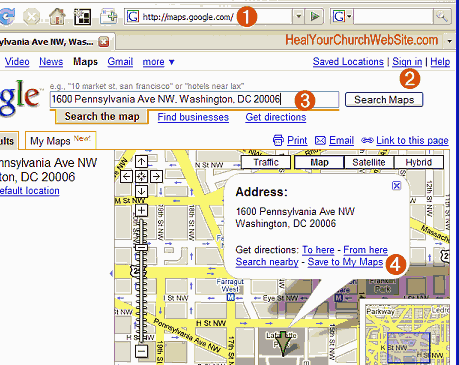
    Steps 1-4 of how to embed a google map

    Step 1:
    Goto maps.google.com (phew, that was easy!-).
    Step 2:
    Login to a gmail account. Yeah, note that even though you’ve added Google aps to your church’s domain, you’ll still need a gmail account. Hopefully one that reflects the name of your church will get it done. Note to Google, how about adding maps to the aps? Please?
    Step 3:
    Now, enter in the address of your church and charity. An alternative is to enter the latitude and/or longitude (uber-geeks please take notem, that would be ‘38°53′55.55″N 77° 2′11.96″W’ in the case of my example).
    Step 4:
    Click on the “Save to My Maps” and either save to and/or create a new maps page for your organization.
    Note: you’ll be entering 2 bits of info, the overall “Map Page” and the individual marker/location. You’ll want this so you can add other addresses markers as needed, like to an off-campus outing, picnics in the park, site of new super-deluxe mega-church construction project, etc …

    step 5 of embedding a google map

    Step 5:
    Modify the description of your marker, taking advantage of the fact that you can enter hyperlinks – like to the rest of your church web site.

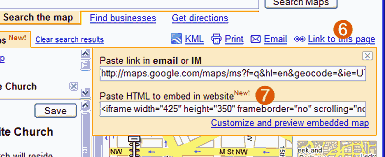
    steps 6 and 7 of embedding a google map

    Step 6:
    Click on the “Link to this page” link.
    Step 7:
    Copy the stuff in the second form text field entitled “Paste HTML to embed in website” … don’t be afraid to resize the map by clicking on the ‘Customize and preview embedded map’ link – especially to make the map tall than wide to better accommodate your ‘step 5’ annotations.
    Step 8:
    Encapsulate the code in a division of your choosing for later CSS control, then either save it to an individual file that you’ll include in other pages, and/or paste it into your directions page – NOT YOUR CHURCH’s FRONT PAGE.
    Remember, this is a Ajaxy-Javascript type of thing, adding this to your front page means you potentially create delays for first time visitors, and or blank boxes if/when the service gets overloaded.
    Also, WordPress users, I might suggest using a plug-in as the editor breaks badly when embedding such iframes – unless you disable the visual editor via your user profile.
    Step 9:
    Test the map from as many different browsers as possible.
    Step 10:
    Collect metrics to see how effective this all is.

    That’s it. And heading my advice in step 8 – you can see an example of it on my website over on a separate ‘direction example‘ page I created for this mad experiment.

    Your mileage will obviously vary, so leave a comment and lemme know how it goes.

    In the meantime, some additional bloggery on the topic:

  • Why Christians Should Have Nothing To Do With Snowmobiles

    7 reasons why snowmobiles are sinful, or a comic-serious example of foolish arguments often used to “prove” that certain things are “worldly” by Norman Street of Diaphero.org – reprinted with written permission:

    Before I became a Christian I went snowmobiling most winter weekends and thoroughly enjoyed it. But now I see the pastime in a different light. True, the church I attend is against snowmobiles and to teach a Sunday School class I had to sign a consecration pledge stating that I do not own a snowmobile and will never ride one. I think that I would have come to this conclusion anyway, because anyone ought to be able to see (if he really thinks about it) that the whole sport of snowmobiling is “out of bounds” and Christians need to think twice before they do anything “just for fun.”

    the devil's work in hot green

    Perhaps it will help others to avoid this form of worldliness if I present some facts and arguments.

    1. Snowmobiles are sinful.
    2. Snowmobiling is a waste of time. Christians are always pleading that they haven’t got time for Bible study. They are too busy to help in the youth work at the church, etc., but they have time to go snowmobiling. Anything which takes up time better spent in spiritual things is wrong for a Christian.
    3. Snowmobiles are harmful to those who ride them. Not only are they in danger of harming themselves, but they may do great harm to others. The finger of suspicion points straight at snowmobiles as the likely cause of increased incidences of ruptured discs necessitating spinal fusions and many other physical ills caused by being jostled and slammed up and down in a vehicle with scarcely any springs or shock absorbers.

      Those who ride them like to invite their friends to join them in the sport. Some of these not so experienced as the owners have suffered serious injuries in accidents such as broken arms and legs. We have heard of people travelling at high speed being decapitated by wire fences. Surely it is wrong for any Christian to endanger his life in a snowmobile.

    4. Snowmobilers have a bad influence. People who own snowmobiles and spend a lot of time with them influence others to get as glued to the sport as they are and Christians should not have such obsessions except in spiritual things things related to the Lord’s work.
    5. Snowmobiling Leads to Worse Things. In spite of all I have said you may not be convinced that snowmobiles are a great evil, but you cannot deny this: they could be the thin edge of the wedge of worldliness creeping in and we must guard against small beginnings.The thing may not be so bad in itself but if it leads to sin then what are we to say? In some places it seems that all trails lead to the tavern where you will see dozens of snowmobiles parked outside.Others go in for racing and of course bets are placed, so the sport brings the Christian into the company of people who gamble and drink. Some of the worst people drive snowmobiles. What part can a Christian have in this business?
    6. The Matter of Christian TestimonySnowmobiles are an annoyance to many people.  They roar up and down polluting the air with exhaust fumes and at night their lights distract motorists and flash into people’s houses. Farmers are afraid to go out at night on their own property for fear they would be struck down. Snowmobilers have no respect for other people’s property or privacy.

      Any Christian wearing a snowmobile suit is therefore a poor testimony. He is bound to be a stumbling block to others. People will say “If that’s what Christians do, count me out. I’ll have nothing to do with Christianity.”

    7. Snowmobiles are an invention of the devil. When the automobile, “the horseless carriage” was invented, preachers warned that it was an invention of the devil and they were laughed at. But no one can deny that the automobile brought on a weekend pleasure craze which kept thousands of people away from the churches.

      How many parents regret that they ever bought an automobile or ever taught their own children to drive? Parents, knowing the dangers were always careful about how and when they used their automobiles, but their young people were reckless. Some drove too fast, killing themselves and injuring their friends. Others parked the automobile down some lovers’ lane . . .The same will be true of snowmobiles. Mark my word. So now you can understand why I will never own a snowmobile. (The fact that I cannot afford one has nothing to do with it.) Nothing could be more worldly than riding snowmobiles and a Christian is plainly told “love not the world, neither the things that are in the world”.

      Furthermore, I will not have fellowship or associate with snowmobilers or with those who do not own snowmobiles but are friendly toward those who do.

    Snowmobilers all sinnin' together

    We would like to meet with others who feel as we do with a view to stamping out snowmobiles. If we could get enough Christians to take a strong stand on this we could form a lobby and work to get legislation enacted prohibiting the manufacture and sale of these terrible machines. We could go from there to tackling other things which take people away from the church every weekend, such as camper and larger pleasure vehicles and private airplanes.

    – – – – – –

    You are not serious? Of course not! But I want you to think. These are the kinds of arguments Christians use to prove that certain things practices, or pastimes are worldly. All we do is prove that we are not very smart and we succeed admirably in looking ridiculous. Many things dogmatically stated here as fact are not even true. Fallacious arguments disgust thinking people. By such arguments as I have used you could strip yourself of everything even your body as the ascetics did. No matter how tired you may be, don’t ever lie on a bed. Wicked people do that. Don’t ever print anything. There’s a lot of bad stuff in print. So, of course, we would never print Bibles.

    Misguided Christians have carried this kind of twisted, illogical thinking to the point where any kind of game or sport or pastime became a sin. Piety was measured by the number of pleasures prohibited; to young and old alike, they had one answer. “You should find all the pleasure anyone needs in work. Enjoy your work. You must not indulge in the world’s foolishness. If you were the Christian you should be you would use leisure hours for Bible study and prayer. You would not be trying to fill the hours with empty pleasures.”

    If I should ask you what is worldliness, how would you reply? With a list of things to be regarded as worldly? Would that be your first answer? Would that be your full answer? I have been a Christian for 50 years and a Pastor for 40. I have learned that Christians whose definition of separation is in avoiding certain things, are likely to be blind to other forms of worldliness. In the sight of God these may be far more damaging to their souls and the souls of others than some of the taboos commonly held by certain groups.

    What do I mean? The spirit of Esau, who would not wait is the worldly spirit of many Christians. What they want, they want now and they get it now. This instant satisfying of every desire, this covetous, materialistic spirit makes Christians appear to be well-off. In reality they are painfully strapped with debt, very unhappy, and unable to give generously to the Lord’s work. That spirit of Esau is surely not of the Father, but of the world.

    Many Christians cannot be content with anything; car, house, furniture, clothing that is not either brand new or in “mint” condition. They knock themselves out trying to keep everything up to an impossible level of perfection. And what are all these things they are so “careful and troubled” about (Luke 12:15)? Temporal things that soon must pass away. Things of this world. That obsession with things and their perfection is worldliness.

    I have seen Christians totally worldly in these and other areas yet so completely unaware of the fact, that they felt themselves to be in a position to judge other Christians because they broke one of the separation taboos. Lest there be a misunderstanding at this point, we need to remember that there are some things which evangelical Christians have always felt should be avoided for the sake of one’s Christian testimony. We may not always agree on each debatable subject but we must respect oneanother’s conscience in these matters.

    Sometimes the list of things prohibited becomes very long because some items are clearly worldly and sinful while others are only considered to be, although it would be difficult to show biblical proof. Such things, in that case, are nothing more than the traditions of the scribes and pharisees in “Christian” guise.

    Happy are those who know the difference between truth and tradition! And happy is he who heeds our Saviour’s Word about removing the beam from his own eye before criticizing or refusing to fellowship with a brother who has only a mote in his eye.

    That thing in our hearts which causes us to set our brother at naught (Rom. 14) and judge him as not qualified to serve in this or that office because he does not agree with us in debatable matters; that spirit is infinitely worse than whatever the “unseparated” brother is doing. Nor will that attitude ever help anyone to deeper consecration, because it is not the spirit of Christ.

    “Lord, what wilt Thou have me to do?” If only that could be our prayer each day. If it is not our heart’s desire to please Him, then what? Nothing else will really work. We can make up our consecration pledges for workers to sign, we can set down lists of things to be avoided by our members, but legal requirements are not God’s way of holiness. Church history clearly shows that those who will conform to legalistic standards inevitably become pharisees.

    True godliness, true consecration, true separation from worldliness and sin springs from only one motive: love for Christ in response to Calvary.

    Love so amazing, so divine,
    Demands my soul, my life, my all.

    That Christian who is constrained by such love, and no other, is free. Free to enjoy innocent fun; Free in testimony. Free in prayer. Free in witness. Free from fear. Free from bondage. Free indeed!

    note: this article was reprinted with written permission from Diaphero.org … thanks for letting us enjoy this here!

  • 5 to ways permanently redirect an old church domain name to a new domain name

    It is no sin for a church to change their domain name. However, it is an unspeakable Internet offense if you do not provide visitors – and search engines – with a quick, simple and painless redirect from the old domain to the new. Unfortunately not all church webmasters know even 1 way to avoid said sin, let alone 5; that is until now:

    While I was surfing about for candidates on another topic, I came across the home page for the Vestavia Hills United Methodist Church of Birmingham, AL … or at least what I thought was the home page.

    Actually, I’m thinking it was the old home page, or a home page whose sole purpose is to redirect visitors from vhumc.org to vestaviahillsumc.org – but does so in a way that gets in the way of seekers and search engines alike.

    To that end, I’ve taken the time to demonstrate five different methods of implementing a search engine friendly, permanent redirect from the old domain name to the new – and in most cases, passing along any query string that may be the result of an old bookmark:

    1. mod_rewrite (via .htaccess)
    # The most preferred, but also at time the most difficult of approaches
    # requiring you modify your .htaccess file as follows:
    RewriteEngine On
    RewriteCond %{HTTP_HOST} ^(www.)?vhumc.org$ [NC]
    RewriteRule ^(.*)$ http://vestaviahillsumc.org/$1 [R=301,L]
    2. Perl:
    #!/usr/bin/perl -w
    # some might argue that this is the most difficult method, and
    # I might tend to agree as a n00b might find out that they should NOT
    # delete the blank spaces and line feeds in between the quote {} tags.
    #
    use strict;
    my $q = ($ENV{'QUERY_STRING'}) ? "?".$ENV{'QUERY_STRING'} : "";
    print qq{Status: 301 Moved Permanantly
    Location: http://www.vestaviahillsumc.org/$q\n\n};
    exit;
    3. ASP classic
    ' # yes, I know we live in the age of .NET, but if you note, today's subject
    ' # is redirecting to an .asp kinda host, so it could be the same for their
    ' # old domain.
    < %@ Language=VBScript %>
    < %
    qs = ""
    if(Request.QueryString.Count > 0) qs = "?" & Request.QueryString
    Response.Status="301 Moved Permanently"
    Response.AddHeader "Location", "http://vestaviahillsumc.org/" & qs
    Response.End
    %>
    4. PHP
    < ?php
    // # perhaps the easiest and most reliable solution for most of you out there
    // get querystring - if it exists
    $q = empty($_SERVER['QUERY_STRING']) ? "" : "?".$_SERVER['QUERY_STRING'];
    // Permanent redirection
    header("HTTP/1.1 301 Moved Permanently");
    header("Location: http://vestaviahillsumc.org/".$q);
    exit();
    ?>
    5. JavaScript
    <script type="text/javascript">
    /*
    # I don't prefer this method as most search engines won't get it, still
    # it is sometimes the only solution a limited webmaster can muster on
    # a limited budget and hosting situation.
    #
    # Also note we don't merely assign a value to href, there is a good reason
    # for this explained here:
    # http://andylangton.co.uk/articles/javascript/javascript-redirect-scripts/
    */
    var qs = window.top.location.search.substring(1);
    qs= (isEmpty(qs) ? "" : "?" + qs);/* capture query string */
    location.replace('http://www.vestaviahillsumc.org/' + qs);
    </script>

    As you can see, there’s more than one way to skin the old redirect cat. Of course there is also more than one way to foul this all up, which is why I’m providing you with a list of additional reading references just in case you find you’ve caused irreparable harm to your website and reputation the above examples as is (note, you’ve just been warned with my disclaimer):

    That said, if you’re still pondering which method to employ, here are my rules of thumb regarding which redirect method to use in which order:

    1. If you have shell access and the know-how:
      .htaccess (mod_rewrite)
    2. If you can’t do it .htaccess
      php
    3. if you can’t do it PHP
      Perl
    4. if you can’t do it Perl
      javascript
    5. if you can’t do it Javascript
      meta tag
    6. if you can’t do the meta tag
      hire some help

    Oh and for those of you who note that I didn’t include a “how to redirect using the refresh meta tag” – it’s because one of the objectives in this exercise is to redirect to preserve search engine visibility and ranking. The unfortunate abuse by spammers of the taggery means potentially hiding your lamp beneath a basket due to no fault of your own.

    For more information on how to modify the .htaccess file to redirect domains can be found here:

    Still interested in reading more on the topic of redirecting from old domains to new domains? Want to see where I got and/or vetted some of my solutions?

  • Bad Church Website Design Poster #0002 – Kitsch Art

    Kitsch /kɪtʃ/ is a term of German/Yiddish origin that has been used to categorize art that is considered an inferior copy of an existing style. The term is also used more loosely in referring to any art that is pretentious to the point of being in bad taste, and also commercially produced items that are considered trite or crass1.

    bad church web design poster #0002 - kitch artKitsch is the term that comes to mind whenever I see cheap, cheesy clip-art gratuitously grafted into a church website.

    Sorry folks, but nothing conveys the antithesis of a rich worship experience than to see a website cluttered with Christian cruft in the form of spinning crosses, low-res icons and cliches art.

    As always, you can click on the small image to see the big image.

    As always, please no hot-linking w/out providing a link back here (to the article, not just the picture :-).

    And as always, I welcome comments, in love, if you have an idea, suggestion and/or … um … comment.