Month: August 2007

  • How to (really) embed Google Maps on your church website

    I think it is safe to assume that getting people into the pews is a conversion goal most, if not all church websites share. But how are guests going to eat all the donuts and sleep through the sermons if they can’t figure out how to get there? One sure way to kill off the ‘it was hard to find’ excuse is embedding Google Maps on the directions page of your church website. Especially now as Google claims to have made embedding as easy a 1-2-3; though I personally think it takes about 10 real-world steps.

    Steps 1-4 of how to embed a google map

    Step 1:
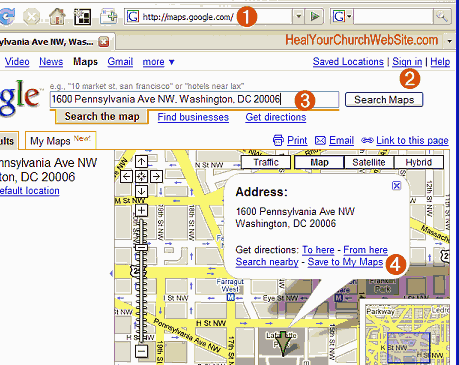
    Goto maps.google.com (phew, that was easy!-).
    Step 2:
    Login to a gmail account. Yeah, note that even though you’ve added Google aps to your church’s domain, you’ll still need a gmail account. Hopefully one that reflects the name of your church will get it done. Note to Google, how about adding maps to the aps? Please?
    Step 3:
    Now, enter in the address of your church and charity. An alternative is to enter the latitude and/or longitude (uber-geeks please take notem, that would be ‘38°53′55.55″N 77° 2′11.96″W’ in the case of my example).
    Step 4:
    Click on the “Save to My Maps” and either save to and/or create a new maps page for your organization.
    Note: you’ll be entering 2 bits of info, the overall “Map Page” and the individual marker/location. You’ll want this so you can add other addresses markers as needed, like to an off-campus outing, picnics in the park, site of new super-deluxe mega-church construction project, etc …

    step 5 of embedding a google map

    Step 5:
    Modify the description of your marker, taking advantage of the fact that you can enter hyperlinks – like to the rest of your church web site.

    steps 6 and 7 of embedding a google map

    Step 6:
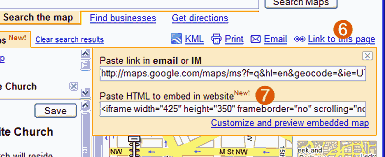
    Click on the “Link to this page” link.
    Step 7:
    Copy the stuff in the second form text field entitled “Paste HTML to embed in website” … don’t be afraid to resize the map by clicking on the ‘Customize and preview embedded map’ link – especially to make the map tall than wide to better accommodate your ‘step 5’ annotations.
    Step 8:
    Encapsulate the code in a division of your choosing for later CSS control, then either save it to an individual file that you’ll include in other pages, and/or paste it into your directions page – NOT YOUR CHURCH’s FRONT PAGE.
    Remember, this is a Ajaxy-Javascript type of thing, adding this to your front page means you potentially create delays for first time visitors, and or blank boxes if/when the service gets overloaded.
    Also, WordPress users, I might suggest using a plug-in as the editor breaks badly when embedding such iframes – unless you disable the visual editor via your user profile.
    Step 9:
    Test the map from as many different browsers as possible.
    Step 10:
    Collect metrics to see how effective this all is.

    That’s it. And heading my advice in step 8 – you can see an example of it on my website over on a separate ‘direction example‘ page I created for this mad experiment.

    Your mileage will obviously vary, so leave a comment and lemme know how it goes.

    In the meantime, some additional bloggery on the topic:

  • Why Christians Should Have Nothing To Do With Snowmobiles

    7 reasons why snowmobiles are sinful, or a comic-serious example of foolish arguments often used to “prove” that certain things are “worldly” by Norman Street of Diaphero.org – reprinted with written permission:

    Before I became a Christian I went snowmobiling most winter weekends and thoroughly enjoyed it. But now I see the pastime in a different light. True, the church I attend is against snowmobiles and to teach a Sunday School class I had to sign a consecration pledge stating that I do not own a snowmobile and will never ride one. I think that I would have come to this conclusion anyway, because anyone ought to be able to see (if he really thinks about it) that the whole sport of snowmobiling is “out of bounds” and Christians need to think twice before they do anything “just for fun.”

    the devil's work in hot green

    Perhaps it will help others to avoid this form of worldliness if I present some facts and arguments.

    1. Snowmobiles are sinful.
    2. Snowmobiling is a waste of time. Christians are always pleading that they haven’t got time for Bible study. They are too busy to help in the youth work at the church, etc., but they have time to go snowmobiling. Anything which takes up time better spent in spiritual things is wrong for a Christian.
    3. Snowmobiles are harmful to those who ride them. Not only are they in danger of harming themselves, but they may do great harm to others. The finger of suspicion points straight at snowmobiles as the likely cause of increased incidences of ruptured discs necessitating spinal fusions and many other physical ills caused by being jostled and slammed up and down in a vehicle with scarcely any springs or shock absorbers.

      Those who ride them like to invite their friends to join them in the sport. Some of these not so experienced as the owners have suffered serious injuries in accidents such as broken arms and legs. We have heard of people travelling at high speed being decapitated by wire fences. Surely it is wrong for any Christian to endanger his life in a snowmobile.

    4. Snowmobilers have a bad influence. People who own snowmobiles and spend a lot of time with them influence others to get as glued to the sport as they are and Christians should not have such obsessions except in spiritual things things related to the Lord’s work.
    5. Snowmobiling Leads to Worse Things. In spite of all I have said you may not be convinced that snowmobiles are a great evil, but you cannot deny this: they could be the thin edge of the wedge of worldliness creeping in and we must guard against small beginnings.The thing may not be so bad in itself but if it leads to sin then what are we to say? In some places it seems that all trails lead to the tavern where you will see dozens of snowmobiles parked outside.Others go in for racing and of course bets are placed, so the sport brings the Christian into the company of people who gamble and drink. Some of the worst people drive snowmobiles. What part can a Christian have in this business?
    6. The Matter of Christian TestimonySnowmobiles are an annoyance to many people.  They roar up and down polluting the air with exhaust fumes and at night their lights distract motorists and flash into people’s houses. Farmers are afraid to go out at night on their own property for fear they would be struck down. Snowmobilers have no respect for other people’s property or privacy.

      Any Christian wearing a snowmobile suit is therefore a poor testimony. He is bound to be a stumbling block to others. People will say “If that’s what Christians do, count me out. I’ll have nothing to do with Christianity.”

    7. Snowmobiles are an invention of the devil. When the automobile, “the horseless carriage” was invented, preachers warned that it was an invention of the devil and they were laughed at. But no one can deny that the automobile brought on a weekend pleasure craze which kept thousands of people away from the churches.

      How many parents regret that they ever bought an automobile or ever taught their own children to drive? Parents, knowing the dangers were always careful about how and when they used their automobiles, but their young people were reckless. Some drove too fast, killing themselves and injuring their friends. Others parked the automobile down some lovers’ lane . . .The same will be true of snowmobiles. Mark my word. So now you can understand why I will never own a snowmobile. (The fact that I cannot afford one has nothing to do with it.) Nothing could be more worldly than riding snowmobiles and a Christian is plainly told “love not the world, neither the things that are in the world”.

      Furthermore, I will not have fellowship or associate with snowmobilers or with those who do not own snowmobiles but are friendly toward those who do.

    Snowmobilers all sinnin' together

    We would like to meet with others who feel as we do with a view to stamping out snowmobiles. If we could get enough Christians to take a strong stand on this we could form a lobby and work to get legislation enacted prohibiting the manufacture and sale of these terrible machines. We could go from there to tackling other things which take people away from the church every weekend, such as camper and larger pleasure vehicles and private airplanes.

    – – – – – –

    You are not serious? Of course not! But I want you to think. These are the kinds of arguments Christians use to prove that certain things practices, or pastimes are worldly. All we do is prove that we are not very smart and we succeed admirably in looking ridiculous. Many things dogmatically stated here as fact are not even true. Fallacious arguments disgust thinking people. By such arguments as I have used you could strip yourself of everything even your body as the ascetics did. No matter how tired you may be, don’t ever lie on a bed. Wicked people do that. Don’t ever print anything. There’s a lot of bad stuff in print. So, of course, we would never print Bibles.

    Misguided Christians have carried this kind of twisted, illogical thinking to the point where any kind of game or sport or pastime became a sin. Piety was measured by the number of pleasures prohibited; to young and old alike, they had one answer. “You should find all the pleasure anyone needs in work. Enjoy your work. You must not indulge in the world’s foolishness. If you were the Christian you should be you would use leisure hours for Bible study and prayer. You would not be trying to fill the hours with empty pleasures.”

    If I should ask you what is worldliness, how would you reply? With a list of things to be regarded as worldly? Would that be your first answer? Would that be your full answer? I have been a Christian for 50 years and a Pastor for 40. I have learned that Christians whose definition of separation is in avoiding certain things, are likely to be blind to other forms of worldliness. In the sight of God these may be far more damaging to their souls and the souls of others than some of the taboos commonly held by certain groups.

    What do I mean? The spirit of Esau, who would not wait is the worldly spirit of many Christians. What they want, they want now and they get it now. This instant satisfying of every desire, this covetous, materialistic spirit makes Christians appear to be well-off. In reality they are painfully strapped with debt, very unhappy, and unable to give generously to the Lord’s work. That spirit of Esau is surely not of the Father, but of the world.

    Many Christians cannot be content with anything; car, house, furniture, clothing that is not either brand new or in “mint” condition. They knock themselves out trying to keep everything up to an impossible level of perfection. And what are all these things they are so “careful and troubled” about (Luke 12:15)? Temporal things that soon must pass away. Things of this world. That obsession with things and their perfection is worldliness.

    I have seen Christians totally worldly in these and other areas yet so completely unaware of the fact, that they felt themselves to be in a position to judge other Christians because they broke one of the separation taboos. Lest there be a misunderstanding at this point, we need to remember that there are some things which evangelical Christians have always felt should be avoided for the sake of one’s Christian testimony. We may not always agree on each debatable subject but we must respect oneanother’s conscience in these matters.

    Sometimes the list of things prohibited becomes very long because some items are clearly worldly and sinful while others are only considered to be, although it would be difficult to show biblical proof. Such things, in that case, are nothing more than the traditions of the scribes and pharisees in “Christian” guise.

    Happy are those who know the difference between truth and tradition! And happy is he who heeds our Saviour’s Word about removing the beam from his own eye before criticizing or refusing to fellowship with a brother who has only a mote in his eye.

    That thing in our hearts which causes us to set our brother at naught (Rom. 14) and judge him as not qualified to serve in this or that office because he does not agree with us in debatable matters; that spirit is infinitely worse than whatever the “unseparated” brother is doing. Nor will that attitude ever help anyone to deeper consecration, because it is not the spirit of Christ.

    “Lord, what wilt Thou have me to do?” If only that could be our prayer each day. If it is not our heart’s desire to please Him, then what? Nothing else will really work. We can make up our consecration pledges for workers to sign, we can set down lists of things to be avoided by our members, but legal requirements are not God’s way of holiness. Church history clearly shows that those who will conform to legalistic standards inevitably become pharisees.

    True godliness, true consecration, true separation from worldliness and sin springs from only one motive: love for Christ in response to Calvary.

    Love so amazing, so divine,
    Demands my soul, my life, my all.

    That Christian who is constrained by such love, and no other, is free. Free to enjoy innocent fun; Free in testimony. Free in prayer. Free in witness. Free from fear. Free from bondage. Free indeed!

    note: this article was reprinted with written permission from Diaphero.org … thanks for letting us enjoy this here!
  • 5 to ways permanently redirect an old church domain name to a new domain name

    It is no sin for a church to change their domain name. However, it is an unspeakable Internet offense if you do not provide visitors – and search engines – with a quick, simple and painless redirect from the old domain to the new. Unfortunately not all church webmasters know even 1 way to avoid said sin, let alone 5; that is until now:

    While I was surfing about for candidates on another topic, I came across the home page for the Vestavia Hills United Methodist Church of Birmingham, AL … or at least what I thought was the home page.

    Actually, I’m thinking it was the old home page, or a home page whose sole purpose is to redirect visitors from vhumc.org to vestaviahillsumc.org – but does so in a way that gets in the way of seekers and search engines alike.

    To that end, I’ve taken the time to demonstrate five different methods of implementing a search engine friendly, permanent redirect from the old domain name to the new – and in most cases, passing along any query string that may be the result of an old bookmark:

    1. mod_rewrite (via .htaccess)
    # The most preferred, but also at time the most difficult of approaches
    # requiring you modify your .htaccess file as follows:
    RewriteEngine On
    RewriteCond %{HTTP_HOST} ^(www.)?vhumc.org$ [NC]
    RewriteRule ^(.*)$ http://vestaviahillsumc.org/$1 [R=301,L]
    2. Perl:
    #!/usr/bin/perl -w
    # some might argue that this is the most difficult method, and
    # I might tend to agree as a n00b might find out that they should NOT
    # delete the blank spaces and line feeds in between the quote {} tags.
    #
    use strict;
    my $q = ($ENV{'QUERY_STRING'}) ? "?".$ENV{'QUERY_STRING'} : "";
    print qq{Status: 301 Moved Permanantly
    Location: http://www.vestaviahillsumc.org/$q\n\n};
    exit;
    3. ASP classic
    ' # yes, I know we live in the age of .NET, but if you note, today's subject
    ' # is redirecting to an .asp kinda host, so it could be the same for their
    ' # old domain.
    < %@ Language=VBScript %>
    < %
    qs = ""
    if(Request.QueryString.Count > 0) qs = "?" & Request.QueryString
    Response.Status="301 Moved Permanently"
    Response.AddHeader "Location", "http://vestaviahillsumc.org/" & qs
    Response.End
    %>
    4. PHP
    < ?php
    // # perhaps the easiest and most reliable solution for most of you out there
    // get querystring - if it exists
    $q = empty($_SERVER['QUERY_STRING']) ? "" : "?".$_SERVER['QUERY_STRING'];
    // Permanent redirection
    header("HTTP/1.1 301 Moved Permanently");
    header("Location: http://vestaviahillsumc.org/".$q);
    exit();
    ?>
    5. JavaScript
    <script type="text/javascript">
    /*
    # I don't prefer this method as most search engines won't get it, still
    # it is sometimes the only solution a limited webmaster can muster on
    # a limited budget and hosting situation.
    #
    # Also note we don't merely assign a value to href, there is a good reason
    # for this explained here:
    # http://andylangton.co.uk/articles/javascript/javascript-redirect-scripts/
    */
    var qs = window.top.location.search.substring(1);
    qs= (isEmpty(qs) ? "" : "?" + qs);/* capture query string */
    location.replace('http://www.vestaviahillsumc.org/' + qs);
    </script>

    As you can see, there’s more than one way to skin the old redirect cat. Of course there is also more than one way to foul this all up, which is why I’m providing you with a list of additional reading references just in case you find you’ve caused irreparable harm to your website and reputation the above examples as is (note, you’ve just been warned with my disclaimer):

    That said, if you’re still pondering which method to employ, here are my rules of thumb regarding which redirect method to use in which order:

    1. If you have shell access and the know-how:
      .htaccess (mod_rewrite)
    2. If you can’t do it .htaccess
      php
    3. if you can’t do it PHP
      Perl
    4. if you can’t do it Perl
      javascript
    5. if you can’t do it Javascript
      meta tag
    6. if you can’t do the meta tag
      hire some help

    Oh and for those of you who note that I didn’t include a “how to redirect using the refresh meta tag” – it’s because one of the objectives in this exercise is to redirect to preserve search engine visibility and ranking. The unfortunate abuse by spammers of the taggery means potentially hiding your lamp beneath a basket due to no fault of your own.

    For more information on how to modify the .htaccess file to redirect domains can be found here:

    Still interested in reading more on the topic of redirecting from old domains to new domains? Want to see where I got and/or vetted some of my solutions?

  • Bad Church Website Design Poster #0002 – Kitsch Art

    Kitsch /kɪtʃ/ is a term of German/Yiddish origin that has been used to categorize art that is considered an inferior copy of an existing style. The term is also used more loosely in referring to any art that is pretentious to the point of being in bad taste, and also commercially produced items that are considered trite or crass1.

    bad church web design poster #0002 - kitch artKitsch is the term that comes to mind whenever I see cheap, cheesy clip-art gratuitously grafted into a church website.

    Sorry folks, but nothing conveys the antithesis of a rich worship experience than to see a website cluttered with Christian cruft in the form of spinning crosses, low-res icons and cliches art.

    As always, you can click on the small image to see the big image.

    As always, please no hot-linking w/out providing a link back here (to the article, not just the picture :-).

    And as always, I welcome comments, in love, if you have an idea, suggestion and/or … um … comment.

  • Bad Church Website Design Poster #0001 – Christian Bling

    A new category for a new teaching toy – er, I mean tool: Bad Church Web Design Posters. Today’s entry:

    “Christian Bling” – or – “Nothing says ‘welcome to our church’ like a ‘pimped-up’ splash page.”

    thumbnail of bad church web design poster #00001

    Click on the small image to see the big image.

    With this poster’s release, don’t let me catch any of you with rhinestone crosses spinning on a splash page – then again, if you’ve been reading my blog, you’ll know that you shouldn’t even have a splash page, or as Vincent Flanders aptly put it in a January 2001 ibizInterview:

    Wal-Mart doesn’t block the entrance to its stores by making you watch a movie or make you listen to someone who explains the history of the company. That’s what a splash page does. It blocks your visitor from getting to the meat of your site. Also, certain search engines give a higher ranking to the contents of your root page (where the splash page is located) and splash pages rarely have any information. A splash page can hurt your rankings with a search engine.

    Oh, and please, no hot-linking w/out providing a link back here (to the article, not just the picture :-).

  • Submissive Volunteerism versus Spiritual Abuse

    Jesus defined the elements of volunteerism in Mark 10:42-43 and Matthew 23:8. There is only one Master, the rest of us are servants of whom the least will be the greatest. Problem is, when it comes to highly visible ministries such as the church’s web page, parties involved tend to forget that Christ is the Master, and being the least does not mean being a door mat to bullies and blow-hards.

    It’s been almost 12 years since I involved myself in any study of spiritual abuse. No need to since I was helped out the door of a church suffering said ailment in the form of pastoral worship. Here’s the short story:

    • A pastor of 39 years gets the heave-ho by the deacons, and is soon replaced with a new, charismatic personality guy pastor arrives
    • I teach a Sunday school class where I generically warn the 10th graders to test everything, including a pastoral message
    • I get a note on New Year’s Eve telling me I’m no longer a teacher, a week later followed-up by a ‘lay staff’ member, also a Secret Service agent by day, who explains to me that I’m not qualified as I insist my students bring their Bibles to Bible study (he, NOT noting that I gave free Bibles at my own expense to those who didn’t own one &/or were still equipped with a ‘kids’ version).
    • I’m told I need to change my attitude. Others are similarly given the boot for equally bogus reasons.
    • Later it comes out the pastor has a past in the form of an SEC investigation and a personal bankruptcy.
    • Pastor gets up in pulpit and divides church with “those who are with me come forward and show your support” … pastor of singles ministry takes note/names of those who don’t go forward.
    • Five years later, the Washington Post reports said pastor resigns, something about a very, very large sum of money missing due to a tuition scandal/scheme involved with the church’s Christian school.
    • Going back in hopes to see if thing can be healed, I’m excoriated along with others as being the cause for the pastor’s demise.

    So when I read a comment regarding volunteerism being an issue of authority – understand that while I agree one must have a servant’s heart – on the other hand one must be careful of church and charity organizations that exhibit some of the following qualities based on Jeff Van Vonderen’s book, ‘Subtle Power of Spiritual Abuse:’

    Out-loud shaming
    basically belittling born out of “something is wrong with you” if you don’t step into line with your attitude.
    Focus on Performance
    how important you are is based upon earning favor w/those in charge, rather than by administering God’s Grace
    Manipulation
    relationships and behaviors are manipulated by very powerful unspoken rules that facilitate shaming messages
    Idolatry
    focus on performance is facilitated by impossible-to-please judges who distort the image of God to get their goals
    Preoccupation with Fault and Blame
    responsibility and accountability are not the issues here: Fault and blame are the issues. The shame-based system wants a confession in order to know whom to shame.
    Obscured Reality
    if you’re thinking critical about those in authority – even if it is based on truth, then something is wrong with you, you need to change your attitude bub; this starts by ignoring and/or obscuring the actual truth.
    Unbalanced Interrelatedness
    rules take the place of people that feeds upon one’s fears and need for structure in the form of placing the burden of all problems on your shoulders, making you feel selfish and guilty for having needs, not submitting entirely to pastoral authority and/or noting that anything is wrong.

    Note – I’m not asserting that said commenter implied any of the above, but rather their comment jogged my mind into putting the topic of volunteerism and spiritual abuse together. A topic which I could write and speak about for hours, but for the sake of brevity – there are three simple solutions to overcoming spiritual abuse masquerading as volunteerism:

    • Scripture
    • personal boundaries
    • technical specifications

    One need only read about Christ’s interaction with the authority figures of His time to see how ancient the problem of Spiritual Abuse is – and how a single Master, servant-hearted Body focused on loving one another by Grace will get around said problems;

    I might start with Matthew 23, where Christ defines some serious boundaries so the volunteering of your time and technical talents isn’t turned into an opportunity to shame and guilt you into adding animated gifs, auto-loading audio, and a huge image worshiping the pastors proboscis on the front page.

    I’d then do some reading on how to structure a software design description (SDD); the IEEE 1016-1998 has always been my favorite. Having such a formalized process – and an established timeline – will further keep glory seekers and self-appointed ‘experts’ in check, while protecting you from enslavement to never-ending feature creep.

    I’d also then consider reading my post entitled “Mr. Zeldman meet Mike Boyink, one of ‘The New Samaritans’” – and realizing then the need to structure your relationship with your church as you would with any web project and client; even if it means running it like a business. Trust me, the alternative only provides the evil-one with opportunity to ruin your walk, and divide your church.

    There’s more on the topic, much more on this topic that can be found at Watchman.org – starting here:

    Some other useful URLs on this topic as well:

    Again, let me make it clear that I do not interpret last night’s comment was from the spiritual abuse camp, I don’t interpret it that way. It just merely made me think about the topic of where a good servant attitude ends and where spiritual abuse begins; and how perhaps some good old fashioned technical specifications might help avoid the whole mess.

    Yes, please feel free to discuss this topic freely here – disagreement in love is always welcome here!

  • How to stop a run-away cron job

    Earlier this morning, I got a panicky email from a friend whose hosting provider made a boo-boo, launching a CRON job to perform an automated backup every minute instead of once a day. OOPS! While sorta funny, the situation was potentially sorta serious. Here’s the advice I suggested to ‘bash’ the run-away job(s) dead as a doornail:

    Step 1 – stop the cron daemon

    Linux has the ability to start and stop background services on the fly. Known as daemons in *nix parlance, the cron service runs once a minute. So step number one is to stop the cron daemon:

    $ /etc/init.d/crond stop

    or

    $ /sbin/service crond stop

    Which version you’ll employ depends on which version of Linux you’re running, but for clarity, I’ll continue on with the ‘/etc/’ flavor for the rest of this post.

    You can check to see the status of the daemon with the ‘status’ command:

    $ /etc/init.d/crond status

    Step 2 – Remove the errant crontab entry

    First understand that merely removing the errant crontab entry will not kill any run-away jobs currently in process. It will however prevent future jobs run running again. Some might suggest crontab -r … but that’s the sort of nuclear option I’d rather not resort to unless all else fails.

    We’ve discussed modifying contab before, which for most of you is a task that has been somewhat ‘de-geeked’ by means of various command consoles such as cPanel and Plesk.

    However, when dealing with run-away process – it might not hurt to know how to modify crontab from via the shell/command line as HTTP services (e.g. your web-based admin screens) might be unavailable.

    Step 3 – Identify the run-away process

    So far, we’ve been working in the realm of ‘relatively safe.‘ But killing a process, that’s one sure way to shoot one’s foot clean off – so proceed with caution.

    If this is beginning to become all too much for you, it is at this point you can reboot the server and let it do the rest of the dirty work.

    For the brave, caution means enumerating all the active/running processes with as much information possible. On a SUN, that would be ps -ef, on Linux ps aux.

    Of course these commands can potentially list dozens, if not hundreds of processes, so the trick is to limit the results, piping them through grep to filter only those jobs you want/need to see.

    The results should include the process id (PID) of the offending process – and if you’re good with your grep – any related (parent) processes. With that PID, you then use the kill command to wack the runaway process good’n’dead. Here’s an example:
    bash-2.05a$ ps aux | grep “mywebsite”
    mywebsite 11666 0.0 0.2 2444 1344 pts/2 S 23:43 0:00 -bash
    mywebsite 12451 0.0 0.1 1700 604 pts/2 R 23:50 20:00 mybackup
    mywebsite 13074 0.0 0.1 2660 760 pts/2 R 23:50 0:00 ps -aux
    mywebsite 13075 0.0 0.1 1700 604 pts/2 R 23:50 0:00 grep mywebsite
    bash-2.05a$ kill 12451

    BTW, kill -9 can be used to forgo the graceful exit and just kill the process
    now (e.g. do not stop at go, do not collect $200, just drop dead).

    4 – Restart the crontab daemon

    $ /etc/init.d/crond restart

    Disclaimer

    While the above steps worked fine for said friend (no, I’m not ‘said friend’), please note that with any such online advice, such advice, your command-line syntax, results and mileage may vary. Meaning, I disclaim any responsibility of you entirely submarine your system.

    Still, I wanted to document this … just in case …

    … yeah, isn’t that reassuring?-)

  • Volunteerism and the Robert E. Peary Class of 1977 Reunion

    This weekend the Robert E. Peary High School Class of 1977 will hold its 30th year reunion. Whatever comes of the events, one notable failure will be the lack of a strong and effective online presence similar to those suffered by many church and charity websites. Here’s why:

    Some Context

    See if this story doesn’t sound familiar to some of you who have offered your time and talents to church and/or charity web sites …

    .. back in early March of this year, I emailed the reunion committee and offered the following resources for free:

    • free web hosting for the site – all bandwidth included
    • set up a domain name if I/we/you/the committee chooses to buy one
    • provide limited but sufficient email & listserv services to the domain
    • set up an open source community/content-manglement application – such as WordPress
    • set it up with adsense with any click through going to an account established of/for/by … “the committee”
    • support the committee’s need for document collaboration through Google Apps
    • track website usage using Google Analytics
    • hand the keys to the kingdom to whichever committee member wants to run the site, after providing them free online training.

    Here’s the response I got back:

    Thank-you for getting back to me. Let me tell you what we hope to accomplish and you can let me know if you can be of assistance. Please understand in my mind I think what we want is fairly easy and straightforward but then again I have 3 dedicated web staff members who would tell you that I am not always thinking straight. We would like to be able to handle the ticket/advertisement/contribution sales for the reunion on the web. We want to do this for several reasons:

    • Ease to classmates of handling purchases on-line and being able to use a credit card for payment
    • Cash going directly to the bank rather than sitting on someone’s kitchen counter
    • Having a data source for sales so that we do not have to reenter contact information for badges, advertisements and memory book messages

    We are planning on opening a PayPal account to handle the secured payment processing. With the PayPal service it is not necessary to have a shopping cart on the website. In addition, I do not think that we need a dedicated domain as this is a brief project and I have asked [name witheld] if we can put a direct link on the [alumni] site. I envision having a form for classmates to fill out that includes:

    • contact information
    • guest information
    • number of tickets to be purchased
    • cash contributions
    • advertising to be purchased (full page, 1/2 page, 1/4 page and business card)
    • total purchases
    • description of donated items
    • actual ad (pdf format?)
    • memory book statement
    • photos

    As several people on the committee would be working with the data for badges, memory book, etc., we would need multiple access to the data. While a standard text box could be used for the memory book statement, it would not be a problem to have the ad & photos submitted separately through e-mail and outside of the webpage.Please let me know if this is something you could help us with or if you have any other questions.

    The Problem

    In other words “… forget about what you have to offer in terms of a free online community with collaboration, tracking and ad revenue tools – we have an an overly-ambitious e-commerce and badging system in mind, so please limit your thinking to our’s or else no thank you…

    Such responses are not uncommon with churches and charities as well.

    I’ve both experienced and heard via email from a number of you instances where talents offered were talents ignored because it was ‘outside the box’ limiting vision the person in charge.

    Well in some cases, I think it’s an issue of control.

    Examples

    For example, I’ve offered to help with (and not take over) the website of the church I currently attend. The pastor has eagerly handed this offer off to a member of the staff. The staff member has politely ignored my offer – instead opting to wander in the wilderness of PHP failures for six months until they finally subscribed the Community Builder service. Which not a bad choice – but one that could be better leveraged with more effective presentation than what is currently implemented.

    Similarly, when I first moved to the area, I had considered joining another church here in town until I asked about being involved with their web presence. There I was told flat-out that the web committee was set – and would have to wait a year or three before considering my aid (even after explicitly assuring them that I would help, not take-over). As I check on the site today, I see almost 2 years later that not much has changed.

    Finally – that ambitious Robert E. Peary High School Class of 1977 reunion site mentioned in the above communications? I’ll link it up here and let you judge for yourself.

    My Point

    So is this post merely kvetching?! Ah, probably a little – but not because I’m bitter – heck, them saying no only means more spare time and less work for me!

    Rather my post is a wake-up call is to pastors, church staff and other individuals charged with the stewardship of their church and/or charity’s web presence.

    When an individual offers you a loaf of bread – don’t return the offer with a rock (yes, I know that’s an inversion of the metaphor).

    Or put another way, when experienced web developer, a paid software as a service product manager and published usability author is offering their time, resources and talent – cool it with the worries about control and instead consider what it might cost your organization to hire out such expertise and/or services.

    I know I’m not alone here, as some of you have emailed me similar accounts of frustration.

    If so, leave a comment here. It’s time church staff and committee chairs quit ‘beefin‘ about time, tithes and talents while squandering that which is already being offered.