Category: Disruptive Innovation

  • XP is dead – Linux community misses marketing opportunity

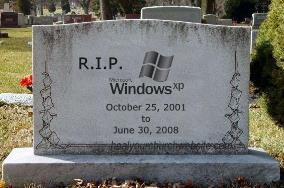
    RIP Windows XP - October 2001 to June 2008After today, Microsoft will discontinue sales of its Windows XP operating system to retailers and major computer makers; this despite protests lodged at InfoWorld’s ad-impaired Save XP petition page.

    Meanwhile, the world of Linux continues to overlook major marketing opportunities – this time missing a chance to dance on XP’s grave by not planning and then announcing releases for any and preferably ALL ‘distro-butions’ today.

    So what does this mean for your church and/or charity organization? For me it is just another reason why Software as a Service (SaaS) solutions such as Zoho and/or ThinkFree.

    Why? Because as long as you have a browser, and in many cases an up-to-date mobile phone with good data services, then you don’t have to worry about jumping through some of the potentially hazardous and most definately expensive flaming hoops required to ‘enjoy’ operating system paradigm shifts.

    For example, you can still get XP once you realize Vista will choke your current hardware platform, but only if you first buy Vista and then “downgrade” to XP (nothing like giving the customer what they want).

    Why bother?

    A comparative cornucopia of online office ’sweets’Instead, if your laypersons and/or church staff are running a variety of computers on a mix of Mac, Ubuntu, or even Windows 2000 systems, no problem. There are many tasty selections from today’s cornucopia of online office ‘sweets’ that offer collaboration capabilities that will not only allow everyone to work-n-play well together remotely, but will also save your budget from all the Advil required to deal with operating system update-induced migraines.

    That and think of the gas everyone will save when you can hold meetings via products such as Skype and collaborate on documents via Google Apps Education Edition; the later provided to registered non-profits with current 501(c)(3) status free-of-charge.

    Bottom line, quit thinking desktop and get that office-ware and associated operations into the collaborative web space.


  • Does XML have a future on the web?

    I’m attending the XML 2007 Conference in Boston – sitting in on a plenary session entitled “Does the XML have a future on the web?” What I hope to share with you is a debate between two interesting and intriguing trains of thought for consideration of publishing not only your church’s website, but also sermons, Bible Studies, weekly calendars and other information your charitable organization needs to distribute.

    Doug Crawford of YahooOne one side, sporting the bearded guru’s view, is Doug Crockford of Yahoo whose response to the insecurities of HTML, Jason and DOM – and whose apparent frustration with XML’s built-in hostility towards traditional programming and database management – has given us the specification known as JSON or JavasScript Object Notation.

    C. M. Sperberg-McQueenIn the mustache only camp is C. M. Sperberg-McQueen, a member of W3C technical staff who asserts that since the Web is for everyone, and because loose coupling and multiple format distribution from a single source are more desired than “fashion” and “delivery speed” that XML will only die when … and I quote “… rip it out of [his] cold dead hands.

    After both individuals gave their opposite opinions – with some in-the middle interjection by Michael Day of YesLogic – what ensued was some impassioned questions from those attending the conference. The responses by both Mr. Crawford and Sperberg-McQueen were equally animated.

    Mostly what I heard from the floor was frustration over the complexity of XML. Crockford took that opportunity to point out how JSON more closely reflect the programmer’s perview. I agree. Sperberg-McQueen pointing out how now modern day browsers now support XHTML + XSLT. I’ll add to this that one only need visit a FeedBurner RSS feed to see this in action.

    When I posed my question how all this fits in to the Software as a Service paradigm, Mr. Crockford enumerated all of the insecurities of AJAX that have become a concern for many developing online applications in an enterprise architecture. Sperberg-McQueen jabbed back with JSON’s eval equates to an equally insecure solution (to XML). Neither answered my question “what do I tell my clients who tell ask me ‘why don’t I go out and get Web 2.0’ … as if it is a product I can purchase off-the-shelf?”

    Neither really answered the question – because the real problem with both JSON and XML as I see it are FREE TOOLS that make it mindlessly easy for the average church secretary to publish a sermon. The same frustration I heard/felt with many of the developers in the audience.

    More later, but feel free to pitch in with your opinions.

  • GospelCom.Net Responds to my Open Letter

    In response to my Open Letter to Christian Media Outlets of July 24, 2002, I received the following response (note, the hyperlinks within the article are mine):

    Date: 7/25/2002
    From: JR Whitby
    To: Dean Peters
    Subject: BG [gospelcom.net #53868]
    Thanks for taking the time to write to us about the Bible Gateway. Dean, With the hundreds of messages we receive for the Bible Gateway each week, it’s nice to get encouraging messages about cool feature requests like this once in a while. ;-)The Bible Gateway does not currently offer the type of interface you’re suggesting, but it is something we’ve been researching for a while. We have been involved with a couple of the initial meetings for the Open Scriptural Information Standard (OSIS) [http://www.bibletechnologies.net/], and are continuing to follow the development of the schema [http://www.bibletechnologies.net/schemadoc.cfm]. We are honored to be working with organizations such as ABS and IBS that are helping lead the way for these standards. This type of work is consistent with the philosophy that’s driven the open source projects we’ve published in the past [http://oss.gospelcom.net/].

    Providing an XML interface is in our plans for the future, and is something we want to provide. We are working to make this type of syndication easier for site owners like yourself, while ensuring we meet the requirements and copyrights of the versions that have been provided to us from the various publishers. As resources become available, we will continue our development along these lines.

    Thanks again for the suggestions!

    Cordially,

    J.R. Whitby
    Vice President, Gospel Communications International
    Director, www.gospelcom.net
    The most popular Christian site on the Internet

    Well, it’s not the answer I wanted, but it sure was the nicest response I could have hoped for. And while I’m glad to see XML in discussion, I’m hoping they’ll realize that XML-based API need not be contingent on the rendering of their systems in XML. In other words, I’m hoping they shoot for an API in the short term, while working on documenting Christendom in XML in the long term.

    Still, a very nice response from a good ways up the food chain.
    Believe me, it IS appreciated!