Tag: maintenance

  • 5 Things that heal your church website

    Last Friday I posed the question “what actually heals a church website?” Now it’s Tuesday and I’d like to talk about this in light of the many excellent comments received.5 remedies to heal your church website

    But first a BIG THANKS to all who participated in this dialog – this was both good and healthy and it is much appreciated.

    1. If it’s broke, please fix it

    “The medicine that heals depends on the illness — if you’ve got a spinning gold cross, removing it becomes job #1” – Mickey

    It’s such a simple point, yet a very salient one. There are some very obvious maladies that afflict our church websites. When we see them, we should fix them.

    For those who don’t know what I’m talking about, I prescribe my post entitled:

    Even if you do know what I’m talking about, it’s a fun read … don’t worry, we’ll be here when you get back.

    2. If it ain’t broke, don’t fix it!

    “I fixed up my church’s website with WordPress and a user-friendly, inviting design. Within months they’d wrecked the colors, changed pictures of people to pictures of furniture, and otherwise mucked it up.” – Jeremy

    Okay, I’m not trying to be a wise-guy here, but I’ve seen this happen all to often. Usually this occurs when an individual has an agenda that it outside the scope of what the church website is trying to accomplish. Two that come to mind are:

    1. On the job training or skills advertising
    2. An ego that can’t share nice things

    Often, I find it’s a combination of the both. My post “Mr. Zeldman meet Mike Boyink, one of ‘The New Samaritans’” comes to mind.

    3. Content is King

    “Even if it has to be black Times New Roman on a stark white background, I’d say job one is relevant content. When, where, what, who, and how, and for good measure, don’t forget why.” – lemon

    I’m thinking ‘lemon’ pretty much summed it all up rather nicely with his/her enumeration of the basics that help us avoid the “Seven deadly sins of web writing.”

    4. Identify your target audience

    There are really (at least) two distinct audiences for a church website:

    1. People not part of your normal congregation, seeking information about your church …
    2. People in the congregation who want to know what’s on this week …

    Since the introduction of this  blog back on May 17, 2002 I’ve been preaching the importance of identifying the purpose and personality of your church website – and then aiming all content, controls and/or contrivances at seekers and members alike.

    Put another way, “A church website that fails to convey the purpose and personality of the congregation and staff will also fail to bring new members into the door.” – Empty Parking Lot Tabernacle

    5. Identify your process & work-flow

    “Unfortunately I think its a people problem, the site is just a symptom. People need to see it as a communication medium and commit to its use. I’m surprised at how poorly email is used by churches, let alone websites.” – David J

    Unfortunately, I think the master of the B2Blog has offered a diagnosis that is as incisive as it it accurate. David accurately points out that unless we understand the work-flow that defines how we:

    • identify things that need fixed;
    • identify things that work;
    • identify what makes compelling content; and
    • identify the target audience of your church’s purpose and personality …

    … then a church website is likely never to get healed no matter what content management system it employs, …

    … no matter how much Flash animation the site does or does not have, …

    … no matter how many social networks the church-geek API’s into the site.

    In short, unless church doesn’t have well defined processes for how to effectively get the right information out to your target audiences, then you’re efforts are like the person Paul describes in 1 Corinthians 9:24-27 as aimlessly batting at the air.

    At least that’s my take. What about you?
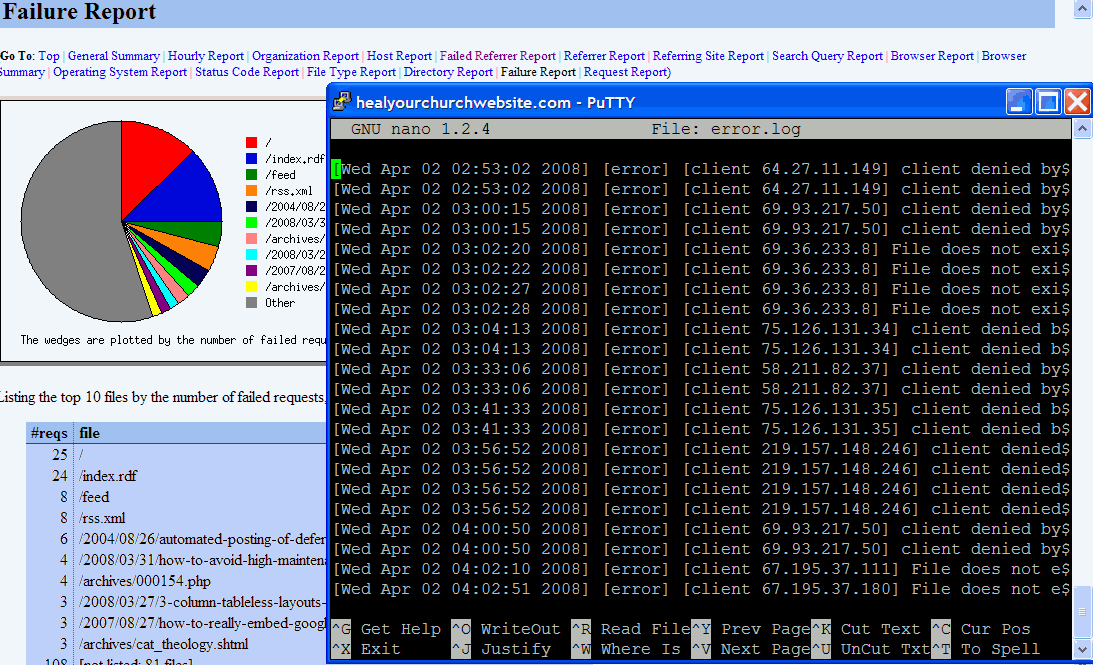
  • How to quickly check your error logs for oddities

     Sample of error logs and stats screensWith more church webmasters taking advantage of free, one-click installs (e.g. WordPress, Drupal, etc …) provided by inexpensive web hosting solutions, I figure it is time to provide a quick tutorial on how to harvest useful operational, user and security information the error logs using a variety of commands already at your disposal – free.

    I have error logs” some ask? To which my response is: “Probably, did you ask your host provider?

    Once you do find your error log file(s) – and most reputable hosts do provide them, usually through whatever host management application they provide (e.g. CPanel, Plesk, etc …) – then it’s time to answer the not asked often enough question “what do I do with them?

    Below is ny semi-definitive, and most certainly emphatic response:

    Resolve 404 errors

    404 is an HTTP response by your website’s server to a user-browser request to a file not found. This information is tracked in your access logs, but usually and often is included in your error logs.

    Here is why this is important to you – reducing 404 errors:

    • reduces user frustration;
    • points out bugs in your configuration;
    • saves you gobs and gobs of disk space;
    • points out potential vulnerabilities; and
    • once fixed, improves available user bandwidth.

    First thing you need to do is figure out how your error log works, and what type of verbose messages it may or may not offer.

    Then you need to make sure you have enough SSH access (e.g. via tools like Putty) to run the Linux commands grep, egrep, tail, more and perl against your error logs.

    Short digression: Yes folks, for today’s lesson I’m assuming you are hosting on some form of a *nix platform – though one can actually perform the following functions on a Windows-based machine applying command line UnxUtils against a long file either on a server or FTP’d to your home computer.

    Getting back to today’s lesson, here’s a simple example of what command-line I would enter if I wanted to see the last 50 lines of my error log:

    tail -50 error.log

    This quickly gives me insight on the type of error messages available. For the ubiquitous 404 error – which in my world is recorded in the error log file in plain English as “File does not exist” … your mileage will likely vary. With this key phrase in mind, I can now enter the command:

    grep "File does not exist" -i error_log

    Parsing logs into human-readable columns

    Problem is, I probably get more information than I want. What I’m simply after is which IP is getting the error, how often, and on what page request. For that, I “pipe” the output from the “grep” command through Perl – which in turn parses the results by spaces.

    grep "File does not exist" -i error_log | perl -l -a -n -e 'print $F[7]," ",$F[12]'

    Counting the spaces, the IP address in my logs hits at position 7, the errant file at column 12. You’ll likely have to figit with these to get it to produce the results you’re interested in.

    Once you do, my suggestion is directing these results into a temporary file you can visit for later use. For example:

    grep "File does not exist" -i error_log | perl -l -a -n -e 'print $F[7]," ",$F[12]' > 404errors.05mar08.txt

    Once you see where the errors are occurring, usually its just a matter of creating a more comprehensive 404 request manager, and/or replacing a file that got accidentally deleted.

    Excluding certain entries

    One last trick – let’s say you’ve fixed two of your errant files, and now want to see what remains in your error log.

    Try this one on for size:

    grep "File does not exist" -i error_log | egrep "\/(file1\.html|file2\.png)" -i -v | perl -l -a -n -e 'print $F[7]," ",$F[12]' > 404errors.05mar08.txt

    Note that I used egrep instead of grep, the ‘e’ standing for regular ‘e’xpressions, which when coupled with the “exclude” operator of ‘-v’, provides us with a list of errant files excluding those you just fixed.

    Closing ‘args’

    I realize that this may sound like ‘ancient geek’ to some. If that’s the case, then my advice is ask your hosting provider what type of error stats may be available through a pre-packaged application that many hosts provide such as “awstats” and/or “webalizer.” They don’t provide the ‘gory details’ one gets with the command line options above, but it’s good enough.

    Yet for those who dare, there are additional benefits to learning how to parse your own error logs – for example, scheduling the above commands (that pipe into a file) in your cron table so you can quickly identify broken files and/or interesting inquiries from bad boys using a variety of anonymous proxy services and/or browsers in an attempt to set-up my blog as their own personal spam-bay.

    You can also save money, support calls, and/or bandwidth by identifying missing pages, images and other fixable omissions.

    For them, I have some .htaccess hacks awaiting them based on the useful input they provided me via my personally parsed error log.

  • Submissive Volunteerism versus Spiritual Abuse

    Jesus defined the elements of volunteerism in Mark 10:42-43 and Matthew 23:8. There is only one Master, the rest of us are servants of whom the least will be the greatest. Problem is, when it comes to highly visible ministries such as the church’s web page, parties involved tend to forget that Christ is the Master, and being the least does not mean being a door mat to bullies and blow-hards.

    It’s been almost 12 years since I involved myself in any study of spiritual abuse. No need to since I was helped out the door of a church suffering said ailment in the form of pastoral worship. Here’s the short story:

    • A pastor of 39 years gets the heave-ho by the deacons, and is soon replaced with a new, charismatic personality guy pastor arrives
    • I teach a Sunday school class where I generically warn the 10th graders to test everything, including a pastoral message
    • I get a note on New Year’s Eve telling me I’m no longer a teacher, a week later followed-up by a ‘lay staff’ member, also a Secret Service agent by day, who explains to me that I’m not qualified as I insist my students bring their Bibles to Bible study (he, NOT noting that I gave free Bibles at my own expense to those who didn’t own one &/or were still equipped with a ‘kids’ version).
    • I’m told I need to change my attitude. Others are similarly given the boot for equally bogus reasons.
    • Later it comes out the pastor has a past in the form of an SEC investigation and a personal bankruptcy.
    • Pastor gets up in pulpit and divides church with “those who are with me come forward and show your support” … pastor of singles ministry takes note/names of those who don’t go forward.
    • Five years later, the Washington Post reports said pastor resigns, something about a very, very large sum of money missing due to a tuition scandal/scheme involved with the church’s Christian school.
    • Going back in hopes to see if thing can be healed, I’m excoriated along with others as being the cause for the pastor’s demise.

    So when I read a comment regarding volunteerism being an issue of authority – understand that while I agree one must have a servant’s heart – on the other hand one must be careful of church and charity organizations that exhibit some of the following qualities based on Jeff Van Vonderen’s book, ‘Subtle Power of Spiritual Abuse:’

    Out-loud shaming
    basically belittling born out of “something is wrong with you” if you don’t step into line with your attitude.
    Focus on Performance
    how important you are is based upon earning favor w/those in charge, rather than by administering God’s Grace
    Manipulation
    relationships and behaviors are manipulated by very powerful unspoken rules that facilitate shaming messages
    Idolatry
    focus on performance is facilitated by impossible-to-please judges who distort the image of God to get their goals
    Preoccupation with Fault and Blame
    responsibility and accountability are not the issues here: Fault and blame are the issues. The shame-based system wants a confession in order to know whom to shame.
    Obscured Reality
    if you’re thinking critical about those in authority – even if it is based on truth, then something is wrong with you, you need to change your attitude bub; this starts by ignoring and/or obscuring the actual truth.
    Unbalanced Interrelatedness
    rules take the place of people that feeds upon one’s fears and need for structure in the form of placing the burden of all problems on your shoulders, making you feel selfish and guilty for having needs, not submitting entirely to pastoral authority and/or noting that anything is wrong.

    Note – I’m not asserting that said commenter implied any of the above, but rather their comment jogged my mind into putting the topic of volunteerism and spiritual abuse together. A topic which I could write and speak about for hours, but for the sake of brevity – there are three simple solutions to overcoming spiritual abuse masquerading as volunteerism:

    • Scripture
    • personal boundaries
    • technical specifications

    One need only read about Christ’s interaction with the authority figures of His time to see how ancient the problem of Spiritual Abuse is – and how a single Master, servant-hearted Body focused on loving one another by Grace will get around said problems;

    I might start with Matthew 23, where Christ defines some serious boundaries so the volunteering of your time and technical talents isn’t turned into an opportunity to shame and guilt you into adding animated gifs, auto-loading audio, and a huge image worshiping the pastors proboscis on the front page.

    I’d then do some reading on how to structure a software design description (SDD); the IEEE 1016-1998 has always been my favorite. Having such a formalized process – and an established timeline – will further keep glory seekers and self-appointed ‘experts’ in check, while protecting you from enslavement to never-ending feature creep.

    I’d also then consider reading my post entitled “Mr. Zeldman meet Mike Boyink, one of ‘The New Samaritans’” – and realizing then the need to structure your relationship with your church as you would with any web project and client; even if it means running it like a business. Trust me, the alternative only provides the evil-one with opportunity to ruin your walk, and divide your church.

    There’s more on the topic, much more on this topic that can be found at Watchman.org – starting here:

    Some other useful URLs on this topic as well:

    Again, let me make it clear that I do not interpret last night’s comment was from the spiritual abuse camp, I don’t interpret it that way. It just merely made me think about the topic of where a good servant attitude ends and where spiritual abuse begins; and how perhaps some good old fashioned technical specifications might help avoid the whole mess.

    Yes, please feel free to discuss this topic freely here – disagreement in love is always welcome here!

  • Volunteerism and the Robert E. Peary Class of 1977 Reunion

    This weekend the Robert E. Peary High School Class of 1977 will hold its 30th year reunion. Whatever comes of the events, one notable failure will be the lack of a strong and effective online presence similar to those suffered by many church and charity websites. Here’s why:

    Some Context

    See if this story doesn’t sound familiar to some of you who have offered your time and talents to church and/or charity web sites …

    .. back in early March of this year, I emailed the reunion committee and offered the following resources for free:

    • free web hosting for the site – all bandwidth included
    • set up a domain name if I/we/you/the committee chooses to buy one
    • provide limited but sufficient email & listserv services to the domain
    • set up an open source community/content-manglement application – such as WordPress
    • set it up with adsense with any click through going to an account established of/for/by … “the committee”
    • support the committee’s need for document collaboration through Google Apps
    • track website usage using Google Analytics
    • hand the keys to the kingdom to whichever committee member wants to run the site, after providing them free online training.

    Here’s the response I got back:

    Thank-you for getting back to me. Let me tell you what we hope to accomplish and you can let me know if you can be of assistance. Please understand in my mind I think what we want is fairly easy and straightforward but then again I have 3 dedicated web staff members who would tell you that I am not always thinking straight. We would like to be able to handle the ticket/advertisement/contribution sales for the reunion on the web. We want to do this for several reasons:

    • Ease to classmates of handling purchases on-line and being able to use a credit card for payment
    • Cash going directly to the bank rather than sitting on someone’s kitchen counter
    • Having a data source for sales so that we do not have to reenter contact information for badges, advertisements and memory book messages

    We are planning on opening a PayPal account to handle the secured payment processing. With the PayPal service it is not necessary to have a shopping cart on the website. In addition, I do not think that we need a dedicated domain as this is a brief project and I have asked [name witheld] if we can put a direct link on the [alumni] site. I envision having a form for classmates to fill out that includes:

    • contact information
    • guest information
    • number of tickets to be purchased
    • cash contributions
    • advertising to be purchased (full page, 1/2 page, 1/4 page and business card)
    • total purchases
    • description of donated items
    • actual ad (pdf format?)
    • memory book statement
    • photos

    As several people on the committee would be working with the data for badges, memory book, etc., we would need multiple access to the data. While a standard text box could be used for the memory book statement, it would not be a problem to have the ad & photos submitted separately through e-mail and outside of the webpage.Please let me know if this is something you could help us with or if you have any other questions.

    The Problem

    In other words “… forget about what you have to offer in terms of a free online community with collaboration, tracking and ad revenue tools – we have an an overly-ambitious e-commerce and badging system in mind, so please limit your thinking to our’s or else no thank you…

    Such responses are not uncommon with churches and charities as well.

    I’ve both experienced and heard via email from a number of you instances where talents offered were talents ignored because it was ‘outside the box’ limiting vision the person in charge.

    Well in some cases, I think it’s an issue of control.

    Examples

    For example, I’ve offered to help with (and not take over) the website of the church I currently attend. The pastor has eagerly handed this offer off to a member of the staff. The staff member has politely ignored my offer – instead opting to wander in the wilderness of PHP failures for six months until they finally subscribed the Community Builder service. Which not a bad choice – but one that could be better leveraged with more effective presentation than what is currently implemented.

    Similarly, when I first moved to the area, I had considered joining another church here in town until I asked about being involved with their web presence. There I was told flat-out that the web committee was set – and would have to wait a year or three before considering my aid (even after explicitly assuring them that I would help, not take-over). As I check on the site today, I see almost 2 years later that not much has changed.

    Finally – that ambitious Robert E. Peary High School Class of 1977 reunion site mentioned in the above communications? I’ll link it up here and let you judge for yourself.

    My Point

    So is this post merely kvetching?! Ah, probably a little – but not because I’m bitter – heck, them saying no only means more spare time and less work for me!

    Rather my post is a wake-up call is to pastors, church staff and other individuals charged with the stewardship of their church and/or charity’s web presence.

    When an individual offers you a loaf of bread – don’t return the offer with a rock (yes, I know that’s an inversion of the metaphor).

    Or put another way, when experienced web developer, a paid software as a service product manager and published usability author is offering their time, resources and talent – cool it with the worries about control and instead consider what it might cost your organization to hire out such expertise and/or services.

    I know I’m not alone here, as some of you have emailed me similar accounts of frustration.

    If so, leave a comment here. It’s time church staff and committee chairs quit ‘beefin‘ about time, tithes and talents while squandering that which is already being offered.

  • Mike Boyink on the problem with free ice cream

    Church Webmasters – Stop Working for Free!

    Mike Boyink implores “church webmasters to stop giving it away for free.“. Like many others, has concluded the only reward for free ice cream is complaints about the flavors. Mike also asserts that this lack of perceived value on the part of pastors and staff leads to re-spinning of style over sustaining long streams of substance.

    I’ve learned something interesting: if you give away ice cream, eventually a lot of people will complain about the flavors, and others will complain that you aren’t also giving away syrup and whipped cream and nuts. – Steven Den Beste – USS Clueless – Capitan’s log – final post.

    The above quote immediately came to mind after reading Mike Boyink’s well-justified rant today:

    Are you a web developer working on your church’s website on a volunteer basis?Stop it.

    Immediately.

    Walk away.

    Or start billing for your time, at rates competitive in the local market.

    Why?

    Knowing what Mike went through with the whole RidgePoint debacle I’m tend to agree.

    For example: Just recently I just helped out OnMission.com with an article on search engine optimization. They offered me a small honorarium but since they are part of the North American Mission Board I opted they keep the cash for those out in the field … and hoped they would provide me with a mere hyperlink.

    Instead, many of my thoughts wound-up being attributed to someone else in the form of an interview (with that someone else). Perhaps if I had invoiced them what my time, OnMission would have have made more of an effort to return the favor in the form of some electronic recognition (though my name is buried in the masthead, in an 8pt font some 47 pages away from the article). My mistake for not asking for the link up-front, their mistake for not understanding the worth of what they were given.

    Likewise in Mike’s post, I happen to know the church site he’s talking about and know they are about to make an expensive mistake … but worse, I think Boyink hits the nail on the head when speaking of the ‘great cloud of witlessness’ that is the Body online. Regardless of whether its FrontPage, Publisher or whatever the WYSIWYG toy-of-the moment happens to be, Mike is dead right when he writes:

    I’m seeing a pattern here, and it angers me. It angers me that, as the church, we can always find the time and motivation to re-implement a site on a different backend, or change the site architecture, or implement new navigational widgets.But try…just try…to find someone to invest that same effort in writing interesting, valuable content. Or documenting people’s stories for the web. Or talking at a strategic level about what the church should be using the internet for. Try it and you’ll get unanswered emails, unreturned phone calls, and blank stares in meetings.

    The emphasis is mine, but I suspect its an accurate assessment of what’s being yelled at on the other side of Mike’s computer!-)

  • Mr. Zeldman meet Mike Boyink, one of ‘The New Samaritans’

    During my short career as an opera singer in NYC, I lived by some hard and fast rules; one of these personal mandates being:

    “Avoid singing for free, and under NO circumstances should you pay to sing.”

    Why – that is why pass on some opportunities to “showcase” my talents merely because of money? Because it was my experience that those of us who were paid, even just a modest honorarium, were invariably treated better than those who weren’t; while those who paid to “showcase” their talents were routinely treated like crap.

    After reading Jeffrey Zeldman’s post entitled “The New Samaritans,” and the Wired Magazine article on which the post was based “Changing the Face of Web Surfing,” I wonder sometimes if those of us who provide free web design services for churches wouldn’t get a bit more respect if we didn’t send said charities a bill for our services?

    The Odeon Saga

    Consider the case cited both by Zeldman and Wired of Matthew Somerville, an Oxford University math graduate who out of frustration redesigned the website Britain’s Odeon cinema chain – gratis. In fact, this free work was so stellar that Zeldman wrote:

    “Mr Somerville did Odeon a favor by solving some of the site’s worst problems …”

    How did Odeon respond to not having to spend thousands of dollars to enlist a top-notch ‘do-over’ firm such as 37Signals? Again quoting Mr. Zeldman:

    “As it turns out, Odeon has hired a consultancy that specializes in the very work Mr Somerville did free.”

    Ridge Point

    Now if this sounds vaguely familiar to some of you, it is because it smacks of a similar treatment Mike Boyink received after volunteering $7,500 worth of billable hours to develop one of the premier church websites on the Internet; Ridge Point Community Church.

    Here’s a very quick chronology for those of you unfamiliar with the story:

    • November 10, 2003 – After 18 months of work, Mike Boyink announces a pMachine-driven redesign of the Ridge Point Community Church website.
    • April 14, 2004 – Pastor Jim Liske announces that “The internet is always changing and Ridge Point is changing its website to include everything the old one had and more! After the changeover occurs, you will need to re-register on the site.Translation: Ridge Point decides to shelf the Boyink/pMachine design in favor of a Braunius/e-zekiel design whose sense and sensibility is best described by Tim Bednar in his “Open Letter to Pastor Jim Liske of Ridge Point Church.”
    • June 4, 2004 – Pastor Jim Liske announces a return to the Boyink/pMachine design.

    Having gone through a similar situation myself, NOT at Redland where I’m currently blessed with a VERY grateful and gracious staff, but at my prior church, I can understand “shock and sadness” expressed by Mr. Boyink. I also understand why Mike, like myself, opted to take his talents elsewhere.

    What Would Zeldman Do?

    Realizing that those us who donate our time and skill to our church’s websites are not in it for Earthly rewards or recognition, and taking into account scenarios such as the Somerville/Odean and/or the Boyink/RidgePoint redesigns in mind, the killer question for this weekend’s discussion is: “what would you do in a similar situation?

    For example, would you send the church a bill, which upon its receipt, you’d show up at the church office with a rubber stamp and mark the bill “Paid In Full?” Or would quietly you stick it out, even if it meant dealing with type A++ ministers with a penchant for micro-management?

    It’s the weekend, let’s discuss: