Month: March 2008

  • How to avoid high maintenance church website design

    High Maintenance: Lamborghini v. Mommy VanFor what will it profit a man if his church website is the slickest in the Internet if he has to forfeit a month’s collections just to change the welcome message?

    If you haven’t guessed by the play on Matthew 16:26 (&/or Mark 8:36, &/or Luke 9:25), or the somewhat wordy “bad church web design poster #006,” the topic of today’s “sermonette” is website maintenance.

    You see, there’s a dirty little secret that professional web developers such as Tim Bednar, Mike Boyink, and myself have known for years:

    Creating and designing websites is alluring and hi-profile work – whereas maintaining code and a consistent stream of compelling content is difficult and is about as glamorous as the janitor who keeps the church toilets clean.

    A point made all the more sharper, like a pointy stick in the eye sharper, when you fall into the trap of having that college kid studying home on spring break create for a really super-click Flash-based church website that everyone – and only – those in his age group and demographic can ‘really appreciate.’

    Then the train wreck occurs sometime in early October when said student is back at art school and your poor church Secretary has to post updates from those in the field on summer mission programs.

    Sound Familiar?

    If not, just give it time. Since 2002 when I started out on my crusade to teach, rebuke correct & train others in righteous web design I’ve seen literally hundreds – perhaps thousands – of church websites that went down this path to obscurity and frustration.

    And this is why we find churches equipped with data-driven content management systems, or at least driven-by a reasonable blogging system, providing pages with excellent search engine rankings and the visitors and conversion rates to show for it.

    Sound Good?

    Okay, so if I’ve sold you on the concept that maintenance is the key to a successful online ministry, then perhaps then I can also convince you and/or your church to engage in the following processes to keep it going for years and years even though your resources are tight and your time tighter:

    • Establish a web ministry team comprised of the following mix of talents:
      • a member of the church staff
      • a software developer type
      • a hardware geek
      • a graphic artist type
      • a word-smith
      • a marketeer
    • Consider employing a content management &/or a logging service to render your church website such as:
    • Engage in a formalized design process before writing a single line of HTML/code that includes:
      • reviewing what’s out there
      • understanding your neighborhood
      • setting attainable goals and objectives
      • establishing minimum requirements
      • defining an informational architecture
      • creating a project plan
    • Execute a development plan that includes the following steps:
      • designing a prototype
      • soliciting user feedback
      • building the system
      • testing functionality
      • testing use cases
      • testing loads and bandwidth
    • Follow-up with a maintenance plan that includes:
      • user education
      • staff training
      • analysis of web analytics
      • data & system backups
      • disaster recovery drills
      • security audits
      • error-log reviews
      • checks of search engine ranking
      • software upgrades
    • Security ongoing success with:
      • rotating in/out new members to your committee;
      • occasionally testing new applications and technologies;
      • periodically soliciting feedback from seekers and church members;
      • make sure there’s a line item in the church budget for the website.

    Sound Too Hard?

    Now if you’re panicking a bit over some of the items above – don’t sweat it. If you’ve took my advice to create a team that includes both a hardware and software geek, you’re good to go on those issues like “use-case testing” or “disaster recovery drills.

    And if you’re too small to do the above – again, don’t sweat it – simply figure out what you can do from the above list with what you’ve got, never forgetting that putting up a website is easy – it’s the maintenance that’s a killer.

    For which of you, desiring to build a tower, does not first sit down and count the cost, whether he has enough to complete it? Otherwise, when he has laid a foundation and is not able to finish, all who see it begin to mock him, saying, ‘This man began to build and was not able to finish.’ Or what king, going out to encounter another king in war, will not sit down first and deliberate whether he is able with ten thousand to meet him who comes against him with twenty thousand? And if not, while the other is yet a great way off, he sends a delegation and asks for terms of peace. So therefore, any one of you who does not renounce all that he has cannot be my disciple. – Luke 14:28-33

    (psst: oh yeah, in case you didn’t figure it out, you click on the small image of the poster above to get to the really-big version you can print out and nail to the door of your church)
  • How I fixed my Windows XP Stop c000021a {Fatal System Error} with Knoppix Linux

    Below are steps describing how I used Knoppix Linux to fix the dreaded Windows XP ‘Error Message: Stop c000021a {Fatal System Error} The Session Manager Initialization System Process…’ failure.

    This morning, when I powered-up my computer at work, my Windows XP-based computer booted blue, noting a file error which in turn kicked off an automatic chkdsk scan/fix of my hard drive. I got some coffee and used my smart phone to address email while all this was going on.

    When the system was done “fixing” the broken files, it rebooted to something I’d never seen before – a blue screen of death with the following ubiquitous message:

    Stop: c000021a {Fatal System Error}
    The Session manager initialization system process terminated unexpectedly with a status of 0xc000026c (0x00000000 0x00000000).
    The system has been shut down.

    After a few bouts with the on/off switch, it was clear, I was dead in the water.

    I walked down the hall to visit the IT guys, together we brought up the Microsoft Knowledgebase file #317189 entitled “Error Message: Stop c000021a {Fatal System Error} The Session Manager Initialization System Process…

    It had fun advice like installing Dr.Watson, running a memory dump and then sifting through the disassembled 0’s and 1’s to figure out what broke. Of course one’s machine would have to boot before that byzantine process was possible – a minor point not considered in said documentation.

    There were some other things about registry files, but again, I can’t get to the the C:\> command line prompt then it doesn’t do me much good.

    I did find on the Messenger Plus! Live Forums advice to run the Windows repair and replace my psapi.dll file with an older version, but again, that’d require getting onto the hard drive – and the only way I knew how to do that at this juncture would be take a route similar to the one I wrote about in 2003 in my post entitled:’Linux-based approach to fixing MSBlaster Worm infection.’

    So after digging through a few drawers and CD stacks, I found a Knoppix CD I had ‘burninated’ back in October for my blogging-tour of Jordan. For those of you who don’t know, Knoppix is a Linux distribution based on Debian GNU/Linux designed to be run directly from a CD / DVD.

    So I popped the Knoppix disk into the CD drive, turned on the power switch and within minutes, my machine was back up and running under Windows XP; though part of me wonders if there’s not an Ubuntu install in store for my aging home computer … but I digress …

    Anyway, I figured it might be helpful to some of you out there if I provides some detailed step on how I fixed my broken Windows operating system with Linux:

    1. Boot up your computer from the CD drive with your latest CD ‘burnination’ of Knoppix.
      • For me, this meant hitting the F12 key on boot up, and instructing the computer to boot from the CD/DVD drive instead of the hard drive.
      • This step also assumes that at some time in the past, you downloaded, burned and tested a Knoppix CD.
    2. At the initial ‘boot:’ prompt, hit enter.
      • You may find you’ll need to boot Knoppix with various startup options to make it work on you particular hardware platform.
      • Hitting the F3 key will show you some of those options. You can also find “cheat codes” online.
    3. Hopefully at this point you’ll see a “Windows-like” desktop known as KDE – and with luck – the hard drive in question will appear represented by an icon at the upper left as mounted and available for use.
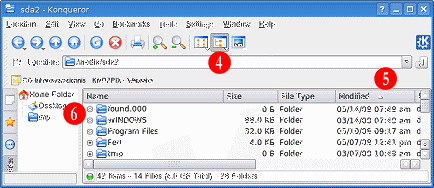
    4. Click on the drive icon that contains your Windows operating system. This will open up (and you Linux fans out there, please forgive me for the term I’m about to use) this will open up an “Explorer like” file window as depicted below:
      Heal Your Church Website: saving Windows w/Knoppix screen 1
      I suggest changing the the display to list the files in ‘detail.’
    5. Sort your directory by date in descending order.
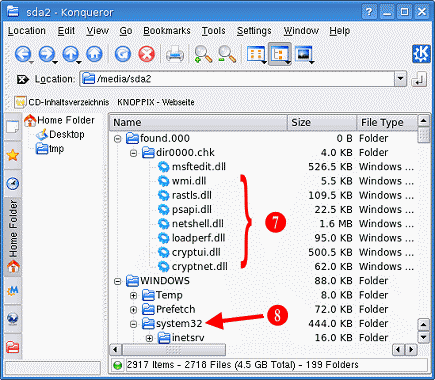
    6. Expand both the found.000 (our found.001..n, etc) and your Windows/System32 directories.
    7. View which files the Windows chkdsk moved into the found.000 path as listed below:
      Heal Your Church Website: saving Windows w/Knoppix screen 1
    8. Check for the same file names in the System32 directory – back them up of need be – then copy the files from the found.000 path into the /Windows/System32 directory; overwriting the existing files by the same name.
      • This is a dangerous move and can entirely mess-up your system -do it at yoru own risk.
      • In my case, I would have made backups, but all of them were of a 0 byte filesize, timestamped this morning at the time of the crash.
      • This is a dangerous move and can entirely mess-up your system -do it at yoru own risk.
      • It never hurts to backup files you’re abut to overwrite.
      • This is a dangerous move and can entirely mess-up your system -do it at yoru own risk.
    9. Shutdown Knoppix correctly (don’t be impatient and just pull the plug:-) – remember to remove the CD from the drive when prompted.
    10. Reboot under Windows.

    DISCLAIMER

    : Warning – I do not recommend this course of action. I am merely enumerating the steps I took to fix my computer under my circumstances, configuration and context. Your mileage may vary – as potentially you risk losing everything in following the same above steps.

    Now if you don’t mind, I have some backups and diagnostics to run. After that, time to go ‘burninate‘ a fresher Knoppix CD; you never know when it’ll come in handy.

    – – – § – – –

    MORE GREAT ADVICE:

    – – – § – – –
  • Inaccessible, that’s what you are

    I find too many church and charity websites putting their best information out of reach. Hence the idea driving today’s bad church web design poster is best sung to the tune of Nat King Cole’s classic, “Unforgettable,” followed by my usual ‘snarkastic‘ enumeration of this pesky issue:

    Inaccessible, that’s what you are
    Inaccessible so near, yet so far
    Like a hy-per-link that eludes me
    How the four-o-four page so annoys me
    Never before has one suffered more

    Heal Your Church Website bad Design Poster #5: Inaccessible

    Inaccessible in many ways
    And forever more, that’s how it stays
    That’s why, ad-min, it’s incredible
    That something so intolerable
    Thinks that I am intolerable too

    <instrumental interlude>
    No never before
    has one suffered more ooh

    Pretty corny? You becha! Pretty common, absolutely. In fact, when it comes to accessibility and church websites – I think the out-of-reach bag of chips pictured in the poster photograph sum up the frustration often felt by many seekers who visit church websites, only to loose their cents and their sanity selecting options that take them nowhere.

    In other words, though most talks of web accessibility are often limited to those topics covered in Mark Pilgrim’s seminal “Dive Into Accessibility” — I would like to expand the conversation today a number of examples where I find church webmasters needlessly impairing their users in the following ways:

    • Bed and breakfast markup
    • Employing browser-specific navigation
    • Charging a fee to read sermons and/or Bible studies
    • Not thinking through the information architecture of the website
    • Displaying Flash content with no browser detection and alternative content

    Bread and BReakfast!

    ‘B and BReakfast markup’ is a handy mnemonic mechanism to memorize how not to semantically collude your online sermons and studies with misused taggery such as < b > and < br >.

    There’s enough existing (x)HTML taggery out there to make your markup match the meaning of your message. Trust me, you’ll thank me for this when you eventually publish a book and/or study guide based on your blogged sermons.

    I write about this in some detail though recent improvements in better-written blogging and CMS applications are making this less and less an issue over time.

    Browser-Specific Navigation

    Here I’m describing those instances where someone employs something like those nifty cool slide-in, drop-down, tree-expanding menus that only work on Microsoft Internet Explorer.

    Or just as evil, uses a DuHtml menu whose sub-choices require the lightening fast reflexes of an over-caffeinated super-hero to click before they disappear.

    Charging for Sermons

    I had actually received an email on the topic – but lost the link (bad dean, bad!). None-the-less, my point is, sermons, Bible studies and other such “opium content” are critical elements that those shopping for churches online use to gauge whether or not they’re going to visit a particular church on Sunday.

    More on this in my post “Is your church website little more than brochureware?

    Information Architecture

    Also known as your informational hierarchy, your navigational hierarchy, your navigation tree and/or your site map.

    This rose by whatever name needs to be well organized enough for the average Joe or Jane to figure out.

    Yes, it means putting down the mouse and thinking first then coding – but it is well worth it as categorizing information enhances church website conversion goals.

    Flashination

    About the only thing more annoying to me than the spinning .gifs of gold lamé crosses on ‘KJV only’ church websites, are Flash-based church websites – or heavy Flash use church websites – that provide no alternative content for those who have not installed the latest and greatest Flash reader plug-in; and/or just don’t view Flash due to restrictions of work, bandwidth and/or physical disability.

    I write on this over-used and/or poorly implemented media all too often here to cite a singular article … so does Vincent Flanders who defines the practice ‘flashination‘ in a slightly more adult parlance.

    Betcha can’t eat just one

    Bottom line is, having inaccessible content is about as frustrating as offering a person a single Lay’s potato chip – whereas making things easy to reach and read is like providing them a sumptuous feast of data that will keep them coming back for more.

    The choice is yours.

  • How to set your system clock in Linux

    So once again, that infernal Daylight saving time thingie bothers us by automatically setting, or perhaps not setting our system clocks on your Ubuntu, Red Hat, Fedora, Debian, Knoppix, or Suse install either an hour ahead, or remaining an hour late!

    the official U.S. timeHere are two simple command lines to synchronize your Linux system clock with the atomic clocks offered by the National Institute of Standards and Technology … hmmmm … atomic energy ….

    … sorry, got distracted with all that power at my disposal. So if you have access to the root account of your server, or better yet – have access to the guy who has access to the root account, here’s all you need to know:

    /usr/sbin/ntpdate -b -s time-a.nist.gov
    /sbin/hwclock --systohc --utc

    Now if you don’t live in the EasternTime Zone as I do, then you’re NOT going to want time-a.nist.gov as your time server. Instead, go to the NIST Internet Time Service page and pick the server that best matches your timezone and daylight savings situation.

    While you’re at it, you can also modify the /etc/rc.d/rc.local file to include the above commands – or at least the first command so it is executed when the server reboots.

    For more gory details on this topic, here is a great little page called Linux Tips – Linux, Clocks, and Time to get ya going in the right place … at the right time (sorry, couldn’t resist the corn-ball humor opportunity).

    Oh and for those in the U.S. who need to set the clock on the VCR (I know some of you still have them … blinking) and/or microwave oven to the correct time, there’s always the human readable the official U.S. time web page, also offered by NIST.

    Like your mileage, your timezone may vary … and I promise … no more ‘geek speak’ for the rest of the week.